The Really Big Picture
Commerce is not growing the way it used to. Everything else in this post follows from that one fact.
Zoom out on US e-commerce and the shape is hard to miss. Roughly 15% annual growth through the 2010s. A 43% spike in the pandemic year. Then four straight years of single-digit growth: 4.9% in 2022, and 5.4% in 2025, the second-slowest rate since the Great Recession.
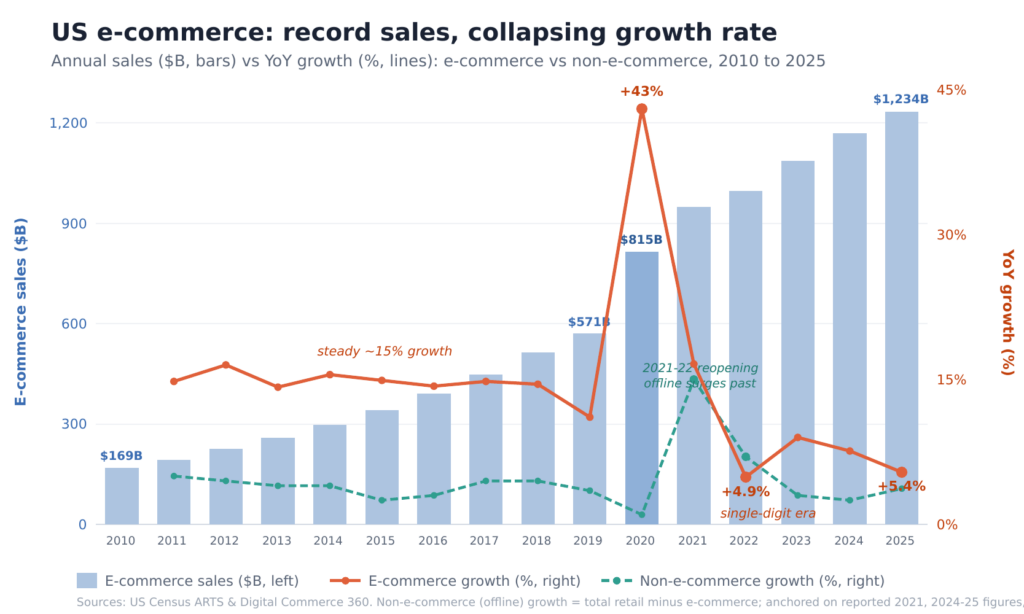
Notice what the chart does not show: a decline. Dollars hit a record every year, reaching $1.234 trillion in 2025. The category did not shrink. It matured. The growth rate collapsed while the absolute number kept climbing.
That distinction is the whole game, because investors price the growth rate, not the level.
Look at the non-e-commerce line. For a decade, online outgrew physical retail by three times or more. After the 2021 to 2022 reopening, the two converged. In 2025, e-commerce grew 5.4% against roughly 3.7% for everything else. Online still wins, but by a point or two, not a landslide. The channel-shift tailwind that justified a decade of commerce investment is largely spent.
Venture capital tells the same story with a sharper edge.
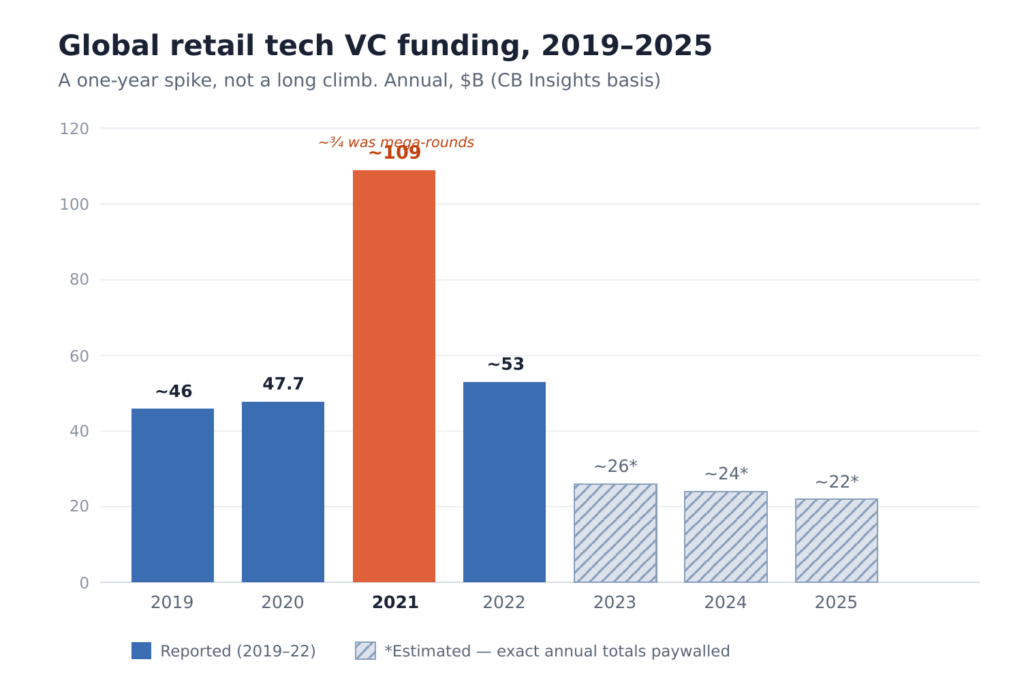
Global retail tech VC funding, 2019 to 2025. Basis: CB Insights.
Retail tech funding sat near $47 billion a year before the pandemic, spiked past $100 billion in 2021 with nearly three-quarters of it in mega-rounds, then fell off a cliff. By 2025 the sector was running down more than 80% from the peak.
The public markets delivered the verdict. VTEX came public in 2021 at more than 25 times revenue and now trades near five times. BigCommerce fell from a high around $130 to under $10. The businesses are fine. The multiples are not. That gap is the market re-rating commerce software from a growth story to a value story.
Forrester has a blunter framing for the demand side: the end of transformation.
Retailers have stopped funding large replatforming projects. As one buyer told Forrester, they cannot justify the business case to replatform. Targeted, incremental changes are replacing full rebuilds.
Why this matters: less e-commerce growth means less budget for commerce software, and a buyer who has stopped rebuilding is a buyer who is not signing large new license deals. Every shift in the vendor market downstream starts here.
From Blue Ocean to Red Ocean
Less growth for brands translates directly into less spend on software. Composability still matters. Buying best-of-breed for its own sake does not.
That new prudence reshaped the vendor landscape, though not in the way a headline count would suggest.
Count the vendors and little seems to have changed. Gartner’s Magic Quadrant for Digital Commerce evaluated 21 vendors in 2015 and 19 in 2025. Nearly flat.
Look at the composition and almost everything changed. The independents on the 2015 list were absorbed:
- Demandware went to Salesforce in 2016 and was rebranded Commerce Cloud.
- Magento went to Adobe in 2018.
- hybris was already inside SAP, folded into the suite.
- CloudCraze went to Salesforce in 2018.
- IBM WebSphere Commerce was carved off to HCL in 2019.
- Insite went to Episerver, which then became Optimizely.
- MarketLive was absorbed into Kibo.
The seat count held because a new wave, commercetools, VTEX, Spryker, BigCommerce, Fluent Commerce, moved in as the old pure-plays were acquired. Then that wave hit the same wall. commercetools raised $140 million in 2021 at a $1.9 billion valuation and has not raised since. It is now waiting on an IPO.
This is what a red ocean looks like. Clear winners and losers are forming.
- Winners: the suites with distribution (Salesforce, Adobe, SAP) and a small set of independents with a defensible reason to exist.
- Losers: the undifferentiated middle, vendors whose only pitch was “we are composable too.”
Nobody buys composable for the sake of composable anymore. Headless, API-first, microservices: these are table stakes, not differentiators. The only question that moves a deal now is whether the software lowers cost and risk against a specific problem.
Pragmatism wins.
The Fork in the Road, Again
The last real fork appeared when headless arrived in the 2010s. Merchants had two options:
- Go cookie-cutter full-stack and accept the constraints.
- Go headless and take full control of the front end.
Take it or leave it. Commerce-in-a-box versus deep customization.
That fork has closed. Full-stack suites added APIs. Point solutions added components. Composability became the default, not the exception. The old choice means nothing now, because every vendor can claim both sides of it.
A new fork has replaced it, and for enterprise buyers it is stricter than before.
- All-in on a composable framework, DIY. commercetools, Fluent Commerce, and the like, chosen when you need something so specific that no packaged product delivers it. You accept the build cost because the customization is the point.
- Unified composable solution. A strong out-of-the-box capability set, with point solutions used only to close real gaps. You replace what you must and leave the rest alone.
Everything between these two is a waste. And Kibo is the only composable vendor positioned as a Leader both in Commerce Solutions and Order Management System reports.
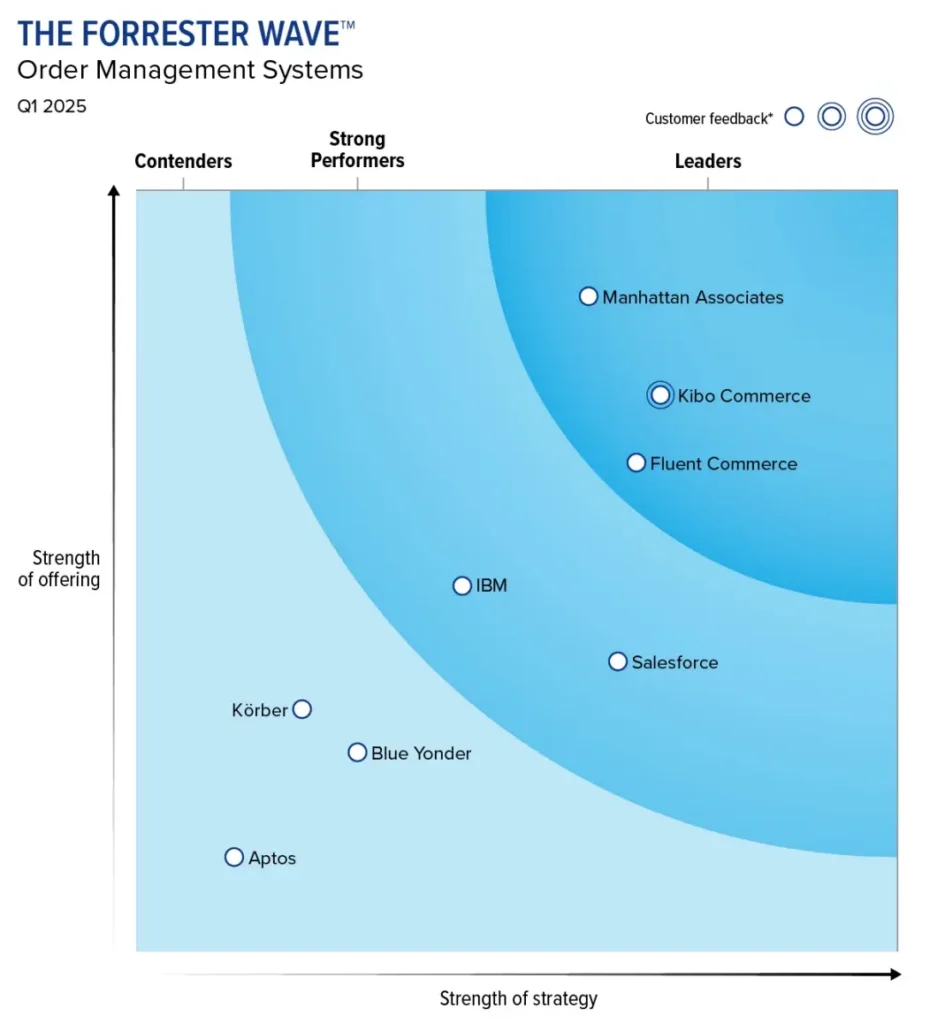

This recognition is more than an accolade. It is a testament to Kibo’s commitment to empowering businesses with the tools they need to succeed. Join the growing list of retailers and brands that trust Kibo to deliver exceptional results.