For branded manufacturers like those across capital equipment, consumer durables, building products, and automotive parts, direct-to-consumer (D2C) channels and digital dealer portals are now standard operational requirements. Kibo is where supply meets demand in real time.
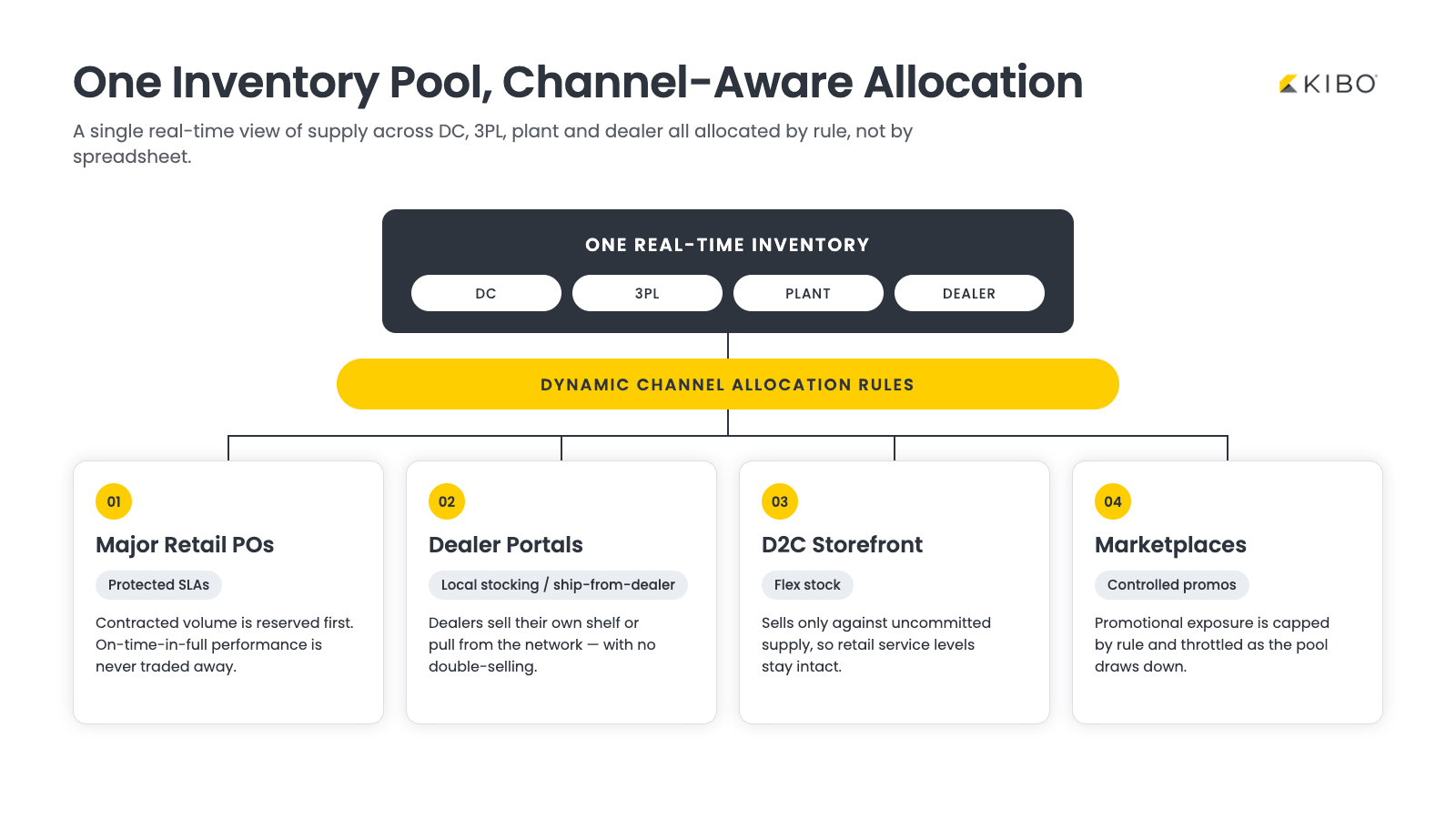
The challenge: manage a single inventory pool across distributor purchase orders, dealer portals, retail partners, and D2C storefronts by aligning connected commercial and operational context to win the order, keep the promise, and protect the margin, without channel conflict or overselling commitments.
The Friction of Shared Stock & Complex Promises
When marketing executes a promotional campaign on a brand’s D2C site built on an unintegrated platform, the storefront can accidentally consume inventory promised to a major retail purchase order. The resulting chargeback and damaged relationship far outweigh the short-term profit of one D2C sale.
Manufactured products need additional promising requirements:
- Configured and made-to-order (MTO) lines cannot be promised from finished-goods stock; delivery dates must factor in production capacity and plant lead times.
- Aftermarket and serialized parts channels suffer when portals lack the technical depth buyers need: part-number search, compatibility data, and serialized tracking.
- Underutilized dealer networks use traditional platforms that treat dealer inventory as isolated, and local dealers as competitors rather than fulfillment assets.
Why KIBO for Branded Manufacturing
KIBO’s B2B order management for manufacturers acts as the central arbitration layer that lets manufacturers orchestrate multiple channels on one inventory pool without hoarding safety stock:
- Channel-aware allocation: Inventory segmentation ring-fences stock by account or channel, and routing logic with channel protection insulate key wholesale and retail commitments while excess inventory flexes across D2C and dealer channels.
- Multitier orchestration: Dealers, distributors, 3PLs, and dropship vendors are evaluated by the same routing engine as your own DCs (on proximity, capacity, cut-offs, and cost), turning the dealer network into fulfillment capacity instead of a blind spot.
- Capacity-based promising: ATP includes lead times for in transit stock, not just warehouse counts, so all finished goods get honest delivery dates.
- Aftermarket parts depth: Granular lot, serial, expiry, and condition tracking; catalogs that hold technical specs and compatibility data; and AI large language model (LLM) search that interprets part numbers and technical terminology so buyers find the right part the first time.
The manufacturing results are measurable: a global automotive parts manufacturer achieved a 3x increase in order throughput capacity, an aftermarket parts distributor lowered implementation costs by 70%, and a large-scale global manufacturer in kitchenware was able to grow average order value by 38%. In August 2026, KIBO was named a Leader in the IDC MarketScape: Worldwide AI-Enabled Order Orchestration and Fulfillment Applications for B2B and Manufacturing 2026 Vendor Assessment, an evaluation built around contract complexity, multitier distribution, allocation under constraint, and integration depth.
By sitting above your ERP as a digital services layer (whether you run one ERP or five), KIBO preserves the back-office financial system of record while unifying storefront promises and multi-channel fulfillment. KIBO is the only Leader in The Forrester Wave™: Commerce Solutions, Q3 2026, to also be named a Leader in The Forrester Wave™: Order Management Systems, Q1 2025. Every promise made across every channel is a promise the operation keeps.
Ready to orchestrate every channel on one inventory pool? Request a demo.