




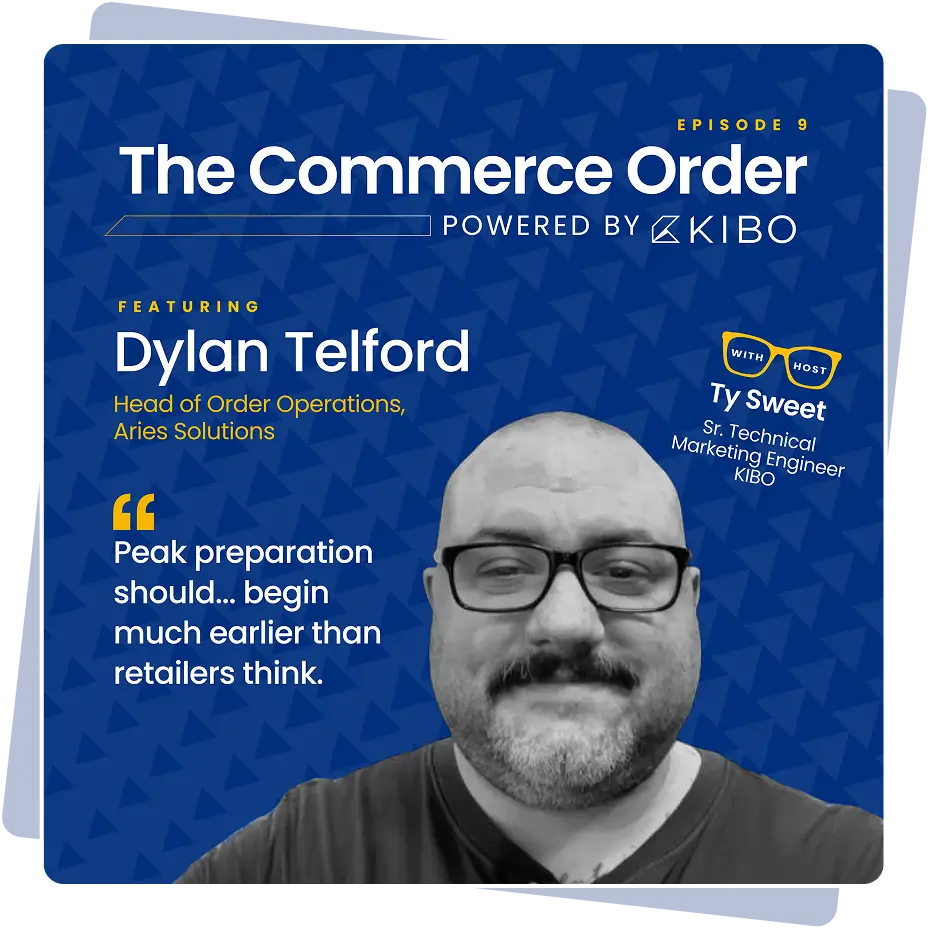
About the Guest


Dylan Telford, Omnichannel Practice Lead at Summit Advisory Team, brings over 20 years of hands-on retail operations experience to the art of peak season readiness. In this episode, Dylan makes the case that peak preparedness isn’t a Q4 sprint — it’s a year-round discipline. He walks through the organizational, operational, and technological building blocks retailers need to stop dreading Black Friday and start winning it.
The conversation covers why post-peak retrospectives only deliver value when they actively shape the next year’s roadmap, and how real-time inventory visibility and flexible order routing rules are the difference between delighted customers and canceled orders. Dylan shares practical frameworks for dynamic DC staffing, responsible performance testing throughout the year, and building a returns strategy that recovers margin rather than just processing volume.
The discussion closes with Dylan’s challenge to retailers on goal-setting: stretch your OKRs, measure often, and stop treating roadmaps as success if performance isn’t following.
Show Highlights
- Why peak preparation should begin the day peak ends — and what a real retrospective looks like.
- How to use real-time inventory management and dynamic order routing rules to protect promise dates during high-volume periods.
- The case for dynamic, part-time on-call staffing models at distribution centers — and why they outperform agency staffing for reliability.
- How to use performance testing throughout the year (not just pre-peak) to avoid surprises when traffic spikes.
- Returns as a margin recovery opportunity: why nearly $900B in annual returns demands a dedicated strategy, not a bullet point on a cost-savings slide.
- The right way to set and stretch OKRs — and why 70% against an ambitious goal often beats 100% against a conservative one.
Transcript
00:01.76
Ty Sweet
All right. Welcome in, everyone, to the show. I’m super excited about the guests that we’ve got today and the and the topic that we’re going to talk about. But before we can dive into the topic, we actually have to introduce the guest and and let them kind of credentialize themselves. So, Dylan, please, why don’t you introduce yourself and and give us a little background on who you are?
00:19.93
Dylan Telford
Absolutely. Thanks for having me. I’m really excited to be here. For everybody, I’m Dylan Telford. I’m the Omnichannel Practice Lead at Summit Advisory Team. ah joined there in 2023, and prior to joining a consulting firm, I’ve been on the operating side of retail for over 20 years and operating, um whether that’s actually hands-on executing ah business needs or if that’s actually building the strategy and helping work with the teams that bring that to life. So I bring a lot of my real world experience into what I do in consulting today.
00:55.55
Ty Sweet
That’s awesome, Dylan. we’re We’re super excited to have you here today, at least at least I am, but I’m sure everyone else is is as well. So, and again, super excited about the topic we got, but before we get to that, there’s always this kind of fun icebreaker question thing that we do.
01:07.71
Ty Sweet
And so I’m going to throw this out to you. ah What is your most controversial opinion?
01:13.62
Dylan Telford
Um, so besides I’m okay with pineapple on pizza. Yeah. um
01:19.39
Ty Sweet
That’s controversial indeed, yes.
01:19.68
Dylan Telford
So this one, when I say it, it shouldn’t feel controversial because we’re not in the heat of the moment of some problem going on. um But something that ah often comes up and that I remind people and I get pushback from time to time on pretty heavily um is When a problem happens and we have to go through, especially if it’s you know in a time crunch, um it’s always more important, in my opinion, to figure out what the triggering action is from a system or an operational standpoint that caused the problem so we can actually diagnose and fix rather than the who caused this, which team, which person.
01:56.80
Dylan Telford
um You’d certainly want to get um to that at some point because you want to be able to understand the full story that you can avoid it in the future. um you know it’s it’s not about accountability in the moment um being held against somebody right you’re not pushing people up against well that’s not go to help anything it’s got to stop you got to take a breath you have to be less worried about whose fault it is and more worried about how do we get things rolling once things are going you got all the time in the world right to figure out what happened and however you’re going to take that action um but i always like to bring this up when people ask me about things that i think are controversial because
02:31.01
Dylan Telford
It’s a good reminder that our emotions can really drive us to make decisions that make us go slower a lot times.
02:37.16
Ty Sweet
Yeah, i totally agree. I mean, at first things first, let’s let’s take care of the issue at hand, and then we can worry about you know what what caused it and then how we prevent that in the future you know kind of later on. But let’s at least ah tackle the problem that we’ve got at this point. So I like it. I like it. it I honestly don’t think it’s all that controversial, but um you know some people might.
02:55.71
Ty Sweet
Some people want to get to the roots of the problem before and… and i I’m with you, man. I feel like that’s not that’s not a beneficial use of time in the in the moment. So um let’s jump into the topic today. you know Typically, we kind of you know start asking questions and kind of let it unfold. But honestly, you you know you and I had ah have had conversations around this.
03:15.38
Ty Sweet
And I’m super excited to talk about this today because it’s you know it’s something that is super popular to to talk about it and a lot of people talk about it and a lot of people talk about it way too late and and this is about you know it’s around peak preparedness right and being ready for for when uh peak season comes upon us uh you know we’re recording this in in you know late september of 2025 so obviously this would be way too late at this point we’re hoping to put this out kind of uh maybe early 26 to kind of get people started on that path but one of the things that we talked about um
03:46.89
Ty Sweet
you know, when we were kind of kicking this idea around was um you mentioned that peak preparation should be kind of a year round process or at least begin much earlier than retailers think. Again, much earlier than than September 29th, I think is today.
04:00.01
Ty Sweet
So how can retailers best prepare for the upcoming peak retail season? and And what are some of the key elements of a successful peak planning strategy?
04:09.75
Dylan Telford
Sure. So I think there’s a few things that are necessary to really just get moving within here. got have somebody on point, right? Somebody’s got to own it. Somebody’s got to be the person that’s kind of bringing everybody else along because this isn’t a one small team kind of exercise. This is the organization at large.
04:28.45
Dylan Telford
um It’s also not technology um specific. It is operations as well because we operate differently when we get in the peak. right So you need somebody who’s going to be able to be a great voice and in between everybody and bring this whole thing together.
04:41.65
Dylan Telford
Now, depending on the size of your company, you might not be able to afford to hire somebody specifically that just does this job. um I think in a lot of cases, you may find that the payoff in the end probably justifies it. But um you could find people who are ready to take that next step of taking on some more responsibility. And this could be part of what they’re doing through the rest of the year. The point being, every you’re doing it all year, you shouldn’t be buried in. it um at any point, right? So you got to have somebody who’s who’s running it um itself.
05:08.82
Dylan Telford
And then you got to have the conversation after peak. And I think a lot of companies are doing this these days. I think with the adoption of agile processes, whether you’re actually applying that um at the the micro level within the work that you’re doing all year, the peak retrospective has become a thing that I think a lot of companies have been putting into play.
05:26.39
Dylan Telford
But is it just talk? Or are you actually applying what you’re getting actively and right away? Right? Like, are you getting ahead of it? And then the other piece is you got to check in throughout the year too, right? Like everything you’re doing in the roadmap ah for changes. And again, those could be technology or operational or combination of both.
05:44.55
Dylan Telford
um Everything that you’re doing is really feeding into, right? Black Friday and when we start getting into peak, right? your Your company’s going into the black because this is where you’re driving such huge numbers.
05:55.61
Dylan Telford
Why are are you waiting? In the end, right? I can guarantee you a lot of this is going a benefit for the rest of the year. If you drove the traffic that you get on Black Friday in May for any reason whatsoever, want to be surprised with that. and you know have systems go down or not be able to account for the operational changes that you need quickly.
06:16.30
Dylan Telford
So I think you’ve got to have the person, got to have the conversation coming out of peak, and then you’ve got to keep talking it through the rest the year. The final piece that is often too big of a challenge to overcome late is you have to have ways to measure your data.
06:34.30
Dylan Telford
You set all the goals you want, but if can’t measure against them, then why are you setting the goal? um Start setting some goals for you know being able to measure the data that you need to be able to measure and then getting you know better at that practice overall.
06:48.05
Dylan Telford
I’d say with those four things, you now have some focus within there. You’ve got the the iterative ability with the conversations that are going on. You’ve got the retrospective with the measurement, hopefully, that you can actually set new goals.
07:01.80
Dylan Telford
And those goals can be set in a way now where you are incrementally making the value difference over the year. um Instead of saying, all right, we’re in October. I need to be able to take three times the traffic that I would normally take.
07:16.87
Dylan Telford
Let’s start hammering the systems to stop doing everything.
07:19.90
Ty Sweet
Yeah, and I think everything you’ve said there is is spot on. um You know, everybody kind of thinks of of Peak as, all right, this is it’s time to gear up and and time to to, you know, kind of throw everything that we’ve got at this and and kind of staff up.
07:31.85
Ty Sweet
if We’re going to do that, and we’ll talk about that in a second.
07:32.06
Dylan Telford
Okay.
07:33.73
Ty Sweet
But I think one of the big ones that that I want to drill down on a little bit is the the insights and the data and and and analytics and roadmap part of that, because I think it’s it’s pretty easy to get overlooked, right?
07:45.52
Ty Sweet
People don’t really look at past… performance, right? How, what happened last peak and how can we start looking at that early on and start to plan for how do we mitigate that moving forward?
07:51.75
Dylan Telford
Thank you.
07:57.13
Ty Sweet
So how can a company use insights from a peak retrospective to inform the roadmap for the following year? And and really what kind of data should companies be looking at beyond customer calls to understand and address um the recurring issues that they’re having?
08:13.07
Dylan Telford
going sound very generic, but you really need to measure your whole business. this could You could have challenges that come from um you know cost and customer expectation challenges with splitting orders, for instance. right And you may be configured in a way where you are costing your business more.
08:31.92
Dylan Telford
You’re missing out on customer expectations. it’s It’s just as bad to ship part of the order. When somebody needs something in a specific amount of time and then have the other piece come late as it is to have the order late emotionally at that time. Obviously, if everything’s late, everything’s late. That’s that’s much worse.
08:49.27
Dylan Telford
But, you know, you could have something like that. You could have you order too much inventory and now you’re getting into your returns period in January and you’re also doing a huge clearance sale and you’re selling inventory you just got.
09:00.68
Dylan Telford
Right. And you’re you’re trying to move through it and you’re losing all the value of that inventory because you maybe bought too much because you you took too big of a bet on that. So you really have to measure the whole business. How did we do from an inventory position, from a sell through standpoint?
09:15.52
Dylan Telford
How did we operate? And that’s multifaceted. So I’m not going to go down that rabbit hole or we’re going to lose our entire time here, but. How do we operate ah in fulfillment? How do we operate our website?
09:26.47
Dylan Telford
How do we operate in our stores? you know Did we need to make changes that we didn’t think about? Did we think the status quo was okay within there? And so you have to be able to measure all of these different pieces, which is why you need to bring these groups together because yeah you want to partner with people. You don’t want have one person that’s running all the analytics for everything and say, got that done. This is what this looked like.
09:45.48
Dylan Telford
And then they don’t know what to do with the rest of their time because it’s up to that point, they’d been hired just to run data on Peek. um You need those teams to come together, own their data, own their insights, and really feed into a roadmap itself.
10:00.27
Dylan Telford
but You want to take the expertise from the people who own those areas of the business and have them driving the changes that are necessary to move the needle rather than yeah somebody who owns peak preparation coming back and saying, oh, by the way, I think you should make this change. Now,
10:16.23
Dylan Telford
Collaboratively, everybody’s input is important, but when you have it owned within these individual areas, it becomes a lot stronger. um Some other things that are top of mind that you want to think about, right, is returns themselves.
10:27.95
Dylan Telford
There’s a really big challenge in returns. it’s I think it was between 22 and 23, there was ah two different surveys that were about is our returns a big issue, and I think it was double or single digits one year, dumped up jumped up like 40 plus percent of companies.
10:44.76
Dylan Telford
think it’s a big deal the next year. And so returns are are a huge issue that don’t say an issue. It’s an accepted challenge within the business um because it’s a customer expectation.
10:57.22
Dylan Telford
um But what are you doing about it in the end there? um and You want to look at, and like I said, you want to look at inventory on your operations themselves, how quickly you’re getting them orders out the door. for customers and how much are they costing you, right? If you’re getting them out the door, but you’re sending them all to stores that have a very low productivity rate and you’re just burying those stores and they’re not taking care of customers that are in store, you’re probably losing out in the long run.
11:20.54
Dylan Telford
and need to look better at at how you filter through that.
11:24.41
Ty Sweet
Yeah, absolutely. and And returns are something what we’ll we’ll talk about momentarily. But you mentioned a couple things there that I think are important. One is is inventory. And obviously, people are going to look at that and be like, yeah, obviously, we’re we’re worried about you know the inventory piece. We need to get more inventory in so we can sell more and and and you know have – make more money, all of those things.
11:42.65
Ty Sweet
But I think there’s some pieces there that that really need to be looked at when when we’re talking about inventory.
11:47.83
Dylan Telford
but
11:47.79
Ty Sweet
So my question to you is, why is it crucial to have real-time inventory management and to adjust order routing rules based on that historical data?
11:56.82
Dylan Telford
Oh, boy. I’ll say you again, there’s nothing worse than being on the receiving side during peak, and whether you’re a friend, parent, loved ones, anybody, it doesn’t matter if you’re getting somebody a gift.
12:10.57
Dylan Telford
within your respected celebration and it doesn’t come on time. um Or it doesn’t come at all. The inventory was so inaccurate that it it got canceled. ah It can be extremely deflating in a time of year where people are trying to be as cheerful as possible as why do we try to stress people at the same time. Not that we’re intentionally doing it, but when we don’t make a change that’s specific for the behaviors that we know we see at that time a year,
12:37.67
Dylan Telford
yeah we’re We’re leading into a lot more customer service issues that are going to cost money as well. On top of, you’re just you know making that time of the year not as special for some people, and it should be a lot easier than that. right So do you need to be a little bit more conservative in how much you protect.
12:53.91
Dylan Telford
Do you need to open up in cases where you do have really efficient stores that are helping fulfill orders? Do you need to open up the aperture a little bit and you know staff appropriately to be able to do just some really heavy fulfillment out of some key stores on top of what you have coming from distribution centers and potentially vendors?
13:09.18
Dylan Telford
um You need to know the the timing of when that stuff’s coming in. Do you promise against future inventory? How accurate is that future inventory? And if it’s not, how do you behave conservatively so you don’t over promise?
13:21.44
Dylan Telford
itself routing rules that one just kills me because it feels like you should be able to get ahead of it right it’s you’ve got a different goal most companies have a different goal at black friday cyber monday through the following week then they do the weeks leading up to something like christmas right um in the beginning you may be looking at how do i optimize my costs because there is some level of expectation you could put out there that orders are going to ship slower right So can you do things in your routing where you can say, these are the most optimal costs that I have, and I’m not missing any expectations for customers, because i’m still getting it there well before their expectation.
14:00.18
Dylan Telford
of of need it’s in the end, ah but I don’t need to write you know kill a specific facility to do so and have those people stressed out as well and going home and having to deal with their own problems.
14:12.48
Dylan Telford
um And then immediately after that, then it does become about urgency. So then you might want to change your rules to tighten things down to be the the absolute highest likelihood of fulfillment on time meeting your promise dates and everything else.
14:26.06
Dylan Telford
Planning for that in advance should be fairly easy because you can experiment through the entire year, right? I can say, I change rule A, I end up saving money as I go through my ship a little bit slower.
14:37.92
Dylan Telford
And then you can undo that and you don’t have to have that set all year. If I change rule B, um I am highly accurate in my fulfillment and my my promise execution.
14:48.62
Dylan Telford
um But it costs me a bit more as I get there. right Find that balance, do that testing. There’s other times the years where we get traffic. And depending on the kind of business, you know, that could be back to school. That could be, um you know, competing with Amazon. It could be really anything.
15:03.79
Dylan Telford
If it’s going to drive traffic, use that as a time to do some, you know, responsible experimentation. But be ready.
15:10.01
Ty Sweet
Thank you.
15:10.64
Dylan Telford
I’m planning for for these days to have this configuration. um If your tool set allows you to, set those configurations in advance to take effect. during that time. If it doesn’t, have the people operationally ready to say, we’re going to go make these changes on this date. We need to cut over. We need to test it, make sure things move through.
15:28.38
Dylan Telford
And then the next day that you need to make change and so on and so forth as you run through. But we shouldn’t act surprised during peak as often as I feel like we do. I feel like we’ve got a lot of knee-jerk reactions that happen because of, oh, oh we got a lot of traffic. Yes, you should been expecting a lot traffic.
15:46.53
Dylan Telford
Oh, we’re slower on shipping. You knew were going be slower on shipping because you got a lot of traffic. Just get ahead of that. Build rules that allow you to be nimble, um but still you’re planned as you move forward and not just reactive. And reactive is most likely going cost you more in the end.
16:06.33
Ty Sweet
Yeah, agreed. and And, you know, you should have, you know, hopefully you’ve got order management platform in place.
16:11.29
Dylan Telford
Okay.
16:11.85
Ty Sweet
and And shameless plug here with Kibo, you know, Kibo allows you to kind of put all of those routing rules together in advance. And then just kind of with one click, you can you can switch those over. But one of the other great things is you can protect yourre your staffing at, you know, say if you’re doing a lot of of ship from store or buy online pickup in store, you know, you can protect the amount of orders that a specific location is going to get so that you’re not overwhelmed, especially when you’ve got a lot more walk-in traffic that’s going to happen during these times, especially Black Friday, um you know, those those specific weekends. So you can set a lot of that up in advance, which is great for the stores,
16:47.97
Ty Sweet
Your distribution centers, however, are obviously going to to see a significant uptick in orders throughout the season, especially days like Cyber Monday, but even throughout the season as more and more people get used to kind of getting things kind of shipped directly to them and not really having to step outside, especially as the temperatures get colder depending on where you live.
16:59.67
Dylan Telford
All right.
17:08.94
Ty Sweet
So can you discuss the importance of dynamic staffing models, especially within those distribution centers?
17:14.77
Dylan Telford
Oh, absolutely. And it can be really hard. It depends on where you are, what the what the um you know economics in your current area for that geography are.
17:25.97
Dylan Telford
um Just availability of of people to be able to do the staffing. A lot of companies, you know they chose where they’re going to choose from a distribution standpoint because there’s other distribution centers there. There’s established routes with carriers. It’s going to cost them less in the end.
17:42.78
Dylan Telford
um But that means you’re fighting for local resources to actually accomplish the work. And often you’ll find that a lot of those folks are working at multiple distribution centers and they’re, they’re you know, they’ve got their own life to live. So they’re trying to figure out.
17:56.68
Dylan Telford
You know, what meets my, you know, my my expectations from how much I’m getting paid, what hours I’m working, my my total availability, how is that impacting my my personal life?
18:07.50
Dylan Telford
um You find a lot of people that have kids and that they just can’t juggle these dynamic schedules that kind of move all over the place. um But what they can do is they can choose the options that they take in in many cases. um And what I mean by that is I worked for a company before that went through a um really interesting experiment that that played out really well. That was with dynamic staffing.
18:31.92
Dylan Telford
um And it was a part-time on-call model. And so they took on a partner that allowed them to essentially hire a lot of part-time staff that’s not necessarily scheduled regularly.
18:44.40
Dylan Telford
um And that staff would have access to an app where open shifts were provided. And within those open shifts, they can say, I want to take that shift.
18:55.78
Dylan Telford
ah We found that because they’re choosing them, they’re more likely to even show up for the shift itself. um And so you’re more likely to have the amount of people that you need to have there if you’re exposing beyond who you’ve got, your trusted team that’s already there and now you’re saying I need to ramp up.
19:15.29
Dylan Telford
I can’t say that this completely gets rid of staff augmentation through agencies, things like that, where you’re going to get potentially 50 people that come in that just help you hammer through a lot of volume. um But those people might show up one day and then just be like, I didn’t really like what I was doing yesterday, so I just am not showing up tomorrow.
19:31.38
Dylan Telford
And it’s it’s very volatile within there and it’s not necessarily feeding into what you were expecting. We’re using part-time on call and they’re more likely to show up and you’re taking these people.
19:41.97
Dylan Telford
A, they’ve already been trained at some point. Yes, if they’re not showing up and working every single week, multiple days as changes happen, need to make sure you give them a little update. Hey, this is different when you come through. um But it feels a lot safer.
19:55.89
Dylan Telford
um when you go through that. And then they can be on staff all year. And you might not staff them very often when you don’t have a lot of high volume. um They might not choose those shifts when they have a lot of high volume. But again, this is somebody who’s sitting that chose to be part-time.
20:09.54
Dylan Telford
They’re not getting benefits paid out from you. They’re they’re on your books and they’re available. And they chose to choose this model. And so when you crowdsource from that group, it showed to be very valuable and be able to fit a lot of those gaps that were needed. The other thing that’s always interesting to look at, and this is really an inclusivity play as well, but there’s depending on where you live, there’s a lot of organizations out there that do assisted um you know career placement and and job placement for people who are neurodiverse.
20:44.44
Dylan Telford
They have um you know autism, for instance. They may have some communication challenges within there. um But some of those places will even have the representative or a representative from the organization come in and, and you’re not paying that person that’s paid by the organization and the person that’s on staff or people they bring on staff, there’s trying to help.
21:06.09
Dylan Telford
You don’t have to hire a staff that now needs to know everything about handling, you know, special needs. um But you’re able to give these people who are looking for jobs and want to be included in, in everything else, you’re giving them another opportunity too. So um not just for peak the rest of the year, but, know,
21:22.08
Dylan Telford
If you’re looking for places to hire people to do work, there’s a lot of people out there that um they just need that opportunity. And I think you know opening to other opportunities is is a powerful way to be able to get through.
21:35.44
Ty Sweet
Yeah, totally agree. and And I like what you say about the the neurodiverse organizations. I’ve worked with organizations in the past that that have provided that that kind of workforce. And I think it’s an excellent ah pool of of workers to pull from, um you know, especially that time of season and giving someone an opportunity to ah to to kind of step up and and do some of those things.
21:54.29
Dylan Telford
Thank you.
21:55.90
Ty Sweet
So I think those are all great, great ideas. um You mentioned something when we were talking about the order routing earlier, and it was it was kind of you know, testing um kind of different types of order routes during, you know, different, kind you know, kind of peaks that you see during the year.
22:11.08
Ty Sweet
You mentioned back to school, some of these other things that kind of crop up ah depending on the the type of industry that you’re in, obviously. And that kind of sparked this idea of like performance testing and kind of doing that ah throughout the year and and kind of getting a grasp on, you know,
22:27.85
Ty Sweet
what you’re going to be able to do during peak. So how can performance testing throughout the year prevent surprises during the peak season? And can companies that are in a code freeze period still find ways to innovate and deliver new value?
22:41.43
Dylan Telford
Yeah, great question. um The code freeze period, I’ll just start for start from the end there, um often is protecting so that these activities can happen. right And so you have built up a lot of functionality over the year against whatever roadmap you’re um working against.
22:59.60
Dylan Telford
and you
23:05.41
Dylan Telford
everything’s coming at once right so so you’re not plowing the road proactively so that you’ve got a little bit to plow you’re plowing everything all at once um roads are shut down you know metaphorically you are potentially just taking on a lot more work through the entire year i mean let’s face it if we’re putting in new code we’re We’re kind of fooling ourselves if we think that it’s not some sort of impact to performance.
23:33.39
Dylan Telford
um Some of it may be a benefit. Great. Find out. No. Right. What did you do there that was a benefit that can potentially be applied to other things? um ah More often than not, we end up just having more functionality and capabilities run through. So things can run a bit slower.
23:48.21
Dylan Telford
um But you should find out at the time um whether, you know if you can perform this quarterly. and pull together everything that you have, this person who’s running point, if they can get that scheduled and get everybody to work together.
24:01.12
Dylan Telford
Who’s to say you can’t pull in your peak to be a lot shorter, of your peak freeze to be a lot shorter of a period because you’re regularly getting ready for volume. um If you’re doing this appropriately and if you’re able to to get this accomplished, you shouldn’t be surprised with the numbers that you’re seeing when you do final performance testing going into the peak because you’ve been testing it the whole time.
24:20.96
Dylan Telford
You see something nudged a little bit, you get it addressed, you move, and yeah I feel like the stress rate should be a lot lower. for people going into peak period and it shouldn’t be this thing that people are dreading that’s coming up to be excited for it.
24:33.97
Dylan Telford
Here’s where we win. i know I’m not going to have to worry about that performance issue as that comes up. So um as often as you could possibly do it, I know it’s difficult um because sometimes when you do these, you’re disruptive to operations as well. So you have to be clever about when you choose those times.
24:50.27
Dylan Telford
But it’s also a reminder, um but performance testing is not limited to systems. i mean come back to operations or impact as well. You need to know how you perform operationally as well.
25:01.00
Dylan Telford
The system can run as fast as the system can run, but if you’re not operating at peak performance, um using peak performance is a different route there, but um if you’re not operating at your highest level,
25:15.93
Dylan Telford
ah you’re not going to be taking advantage of the speed that your system can run through. So again, that can be difficult to work through, but do you have other sales periods that are higher volume that you can maybe use?
25:28.28
Dylan Telford
A great practice that I’ve seen in the past is, um At a time of the year where your expedited shipping tends to be significantly lower than what it is in other times of of the year, can you with you know just hold back orders and say, I’m going to push peak volume to a distribution center?
25:48.52
Dylan Telford
um We’re just going to hold back orders. So we’re not going to have you know a lot of orders or order shipping at all, potentially, if we can accomplish it for a few days. And then we’re going to throw everything at the distribution center um on that you know third, fourth day and really hit heavy volume. So you’re in a real world situation with a lot of volume you through and you have less of a risk of expedited orders need to make them themselves through.
26:12.34
Dylan Telford
um I’ve seen that be very successful. It gets your regular team, you know, your team that’s on all the time. They’re just ready. know, they’re on their toes.
26:21.97
Ty Sweet
Yeah, that’s great. And, and um you know, we’ve mentioned this a couple of times already, and I want to dig into this next topic because it’s obviously important year round, but it’s definitely, you know, increases in significance around the holiday season. It’s around returns, right? We’ve mentioned this once or twice already, I think.
26:39.87
Ty Sweet
um So really, why are returns a significant, often overlooked cost for retailers?
26:40.86
Dylan Telford
Thank you.
26:45.43
Ty Sweet
And what are some proactive strategies for managing returns, especially during the peak season when they spike?
26:51.29
Dylan Telford
Sure. I don’t have this ah quantified from a data standpoint, but I suspect from what I see that returns, again, it tends to be something that’s expected. It’s a capability that we have because not only ourselves and our customers, but you know prospects, any anybody out there who’s shopping um is expecting to be able to get quality out of what they’re buying.
27:14.78
Dylan Telford
And if what they’re buying is not being their quality or there’s a mistake or there’s you know some sort of quality issue that comes along with the product, ideally you have a way to get returned. It’s it’s over and over. You’ll see surveys that are taken from customers that say um they will not consider shopping again at a retailer that doesn’t have an easy…
27:35.37
Dylan Telford
return path for them. So you’re going to be doing returns. Unfortunately, the data says that ah most people at companies are seeing 50% of margin eroded already away from a product that then gets returned you have to sell again. So how do you get the most value out of that product itself?
27:53.41
Dylan Telford
Another reason it’s important, 15% of those returns um tend to be fraudulent. And so that’s just a loss overall. And so and that’s a hard nut to crack. But that’s something to put some some eyes on because that’s not just in peak. That’s the rest of the year. just gets bigger.
28:09.62
Dylan Telford
ah can People take advantage when things get bigger and things are more chaotic. So the less chaos you can have and the more ready that you are, you should be able to limit that. It could take more labor to process a return because you’re taking something in, you’re inspecting it.
28:23.95
Dylan Telford
Now, when we receive inventory from vendors, oftentimes there’s some volume that gets inspected. Not every single unit gets inspected, but like, you know, some boxes get kicked over and they’ll be inspected and QA’d and everything.
28:37.82
Dylan Telford
then they’ll move through. And so new product gets a little bit of a look, but return product, everything’s being looked at when it comes through, right? Is it new in the package? If it’s not new in the package, are all the pieces there and components? Is in the condition that I’m going to sell ah new to a customer? If not, are there escalation paths internally that require other people that you have to get involved with in there? So there’s a, on top of that, cost you had just to get the product in and sell it to begin with.
29:02.60
Dylan Telford
Now you’re adding cost by adding time into what’s happening during the return process. um And then it’s it’s not a small amount, right? It’s returns are significant, hundreds of billions of dollars.
29:15.84
Dylan Telford
I think it was about almost $900 billion dollars last year in returned items that came through. And it’s… A, i see opportunity when I see that, right? What can you do with that inventory?
29:28.95
Dylan Telford
And how can you get some value back out of it? Whether you’re retaining some level of of margin by saying, I got an exchange out of it. ah Maybe you kicked it into an outlet quality. So you’re able to guide a different area of business, attract different types of customers.
29:45.29
Dylan Telford
um There’s some companies that have the opportunity to be able to do used inventory, right? So they come through and say, hey, you’re outside of our return policy, but I can buy it from you. um You’ll see you see this at like electronics and musical instruments, video games, things like that.
29:59.60
Dylan Telford
um you’ll You’ll be able to see that resell kind of side of it. And on that point, you as the retailer get to kind of name what the cost is going to be. in the end, right? If you don’t want that anymore, you want to get something else, again, trade it for something.
30:11.96
Dylan Telford
Here’s what I’m willing to give you for it. And now you’re able to build your margin back based on, you know, I paid X, I got Y out of this. um And I think there’s a lot of opportunities within returns that
30:27.45
Dylan Telford
it’s they’re missed because coming back to the original statement here, it’s a necessity, right? It’s just something that that people feel like they have to do. So you tend to see returns as a bullet point on a overall cost savings initiative.
30:42.17
Dylan Telford
um You don’t tend to see a returns initiative associated with anything and somebody putting a real you know keen eye or taking on partnership to have somebody come in and with a magnifying glass and say, here’s what your total returns ecosystem looks like.
30:55.20
Dylan Telford
You have opportunities here, here, and here, and it should net out to X number of dollars that’s going benefit for the customer and for you in the end.
31:05.42
Ty Sweet
Yeah, absolutely. And I think these are all really great points to to bring up and and things to kind of take into account when when you’re when you’re kind of looking at and going through peak. um Is there anything else, Dylan, that that retailers can leverage? Any tips that you’ve got ah that we haven’t already discussed? Yeah.
31:23.21
Dylan Telford
Sure. um So this one, think more retailers are getting on the OKR bandwagon. um A challenge I’m seeing is they’re not necessarily being executed against the way is intended, right? It’s OKRs in the end are a great way to set goals, but there’s also, if you really get down into and you look at the intent of the OKRs, it’s not just to say, here’s a goal, did I, did I not execute it?
31:52.09
Dylan Telford
The intent to want to be measurable goals within yeah KPIs that you have as a company um that are increases or decreases wherever the value ends up being that you should be stretching to as well.
32:08.02
Dylan Telford
The example that I always give to people is if you know you can grow metric A by 8% and you’re confident you have the way to get there, great. Then when you hit 8%, you hit 8%. Everybody celebrates and you kind of move on.
32:23.47
Dylan Telford
What if you could possibly hit 13% but it’s going to be really hard?
32:30.56
Dylan Telford
Are you going to be upset when you hit 11? No, because you knew you can hit eight and now you hit 11, right? And now you’ve got this growth within. So you’re going to set OK hours, you’re going to take that on some of the business.
32:41.57
Dylan Telford
I challenge people to challenge themselves, really stretch those goals and be OK with 70% execution against it because 70% execution may be more than you expected to get to begin with.
32:54.12
Dylan Telford
It also allows people to get more creative in the problems that they solve. And so as you go throughout the year, if you’re working within your OK hours, and let’s just say you’re you’re not ready to take them on quarterly something like that, and you’re going to take them on for the full year, you still have a number you want to go after. You can still have incremental measurements within there. You can say, hey, I want to by this time and be able to hit this number to show that I’m on track.
33:16.37
Dylan Telford
If you’re not on track, you can pivot. You can say, what I’m doing is not working against what I expected to be able to do. How do I change that outcome and and where do I go? You don’t want to just execute roadmaps, execute roadmaps. They should be delivering the value that you think you should be getting out of it. And we shouldn’t be hearing, I’m putting myself out of business as a consultant from here, but we shouldn’t be hearing um as often people saying, we yeah know we build our roadmap with a lot of rigor and we continue to not see the performance that we expected to see out of our roadmap.
33:46.48
Dylan Telford
What we should be saying is, oh, yeah, we thought we were going to put that in and we decided not to put it in because as we were measuring throughout the year, it was not performing the way that we expected. So we actually shifted to why. Oh, I never heard of that.
33:58.56
Dylan Telford
Great. Here’s what why was important to us. It might not be important to you, but is important to us. And here’s where we move the needle. Now innovation is truly happening and people are doing different things that can trigger new thoughts from others and bring additional value. So if you’re in a goal model that uses something like OKRZ,
34:13.80
Dylan Telford
I urge you very much to stretch, measure often. um Within there with measure, if you don’t have a strategy for your data um throughout the entire year to just get better at how you, the visibility that you have, how you measure, um how accessible that is to people across the organization.
34:32.72
Dylan Telford
um If you find you have siloed data, speaking of accessibility, that ah my area of the business has a trickle down effect to your area of the business.
34:43.83
Dylan Telford
I should be encouraged to understand what the data looks like in your area of the business so that I know the decisions that I make. If I feel like it’s going to potentially have a trickle-down effect that’s negative, we can get it together in advance and say, hey, is it the right thing to do to begin with? Or if the juice is worth the squeeze heavily on that side, what changes can you make in your area of the business that can account for that?
35:05.78
Dylan Telford
and either offset it or improve it overall to the point where it really doesn’t matter that that trickle through happened. It was expected and you collaborated on a better solution. Those would be my two main items.
35:18.91
Ty Sweet
Awesome. it’s It’s a lot of great information today, Dylan, and I really appreciate you you coming on and and giving out some some tips and pointers. And hopefully everybody kind of took something away today, if not not pretty much everything across the board. I know there was…
35:31.79
Ty Sweet
There was some great points here that I hadn’t considered before for sure. So but before we wrap up fully today, though, would I would be remiss if I didn’t ask you this kind of last question since we’re talking about ah peak season, peak performance, you know, all of that.
35:46.39
Ty Sweet
Do you have any peak season horror stories that you’ve witnessed yourself?
35:50.48
Dylan Telford
I have a lot. um So, um you know, with over 20 years on the client side and and living retail, there’s certainly been a lot. One that stands out to me is I worked for a retailer that um wanted to be clever for margin purposes with the pricing that they were doing during Black Friday.
36:08.69
Dylan Telford
um And what they did was not only did they separate what the general discount online was versus what the discount in store was, they actually changed the discount in store at a different time.
36:22.59
Dylan Telford
So it was 50% off everything online, 50% off everything in store until two o’clock, and then it’s 40% off everything in store. um We’re watching the numbers, we’re watching the traffic, and we are not performing. And I’m sitting there and I’m like, I’m down the street from a mall.
36:42.07
Dylan Telford
I’m going get in the car, I’m going to go, I’m going to go see what’s going on Mall’s hopping. It was impossible for me to find, probably to take a shuttle that I’ve never had to take at this mall before, right? From parking to get to the mall itself.
36:54.49
Dylan Telford
walked around stores just packed their pack their pack going to my store not packed um you know very few people that were in it um and almost all of them had their phones out and they were looking at the sign on the rack versus the sign online that says what the discount is and confused as to why they aren’t the same number and employees were running around trying to get the signs changed so that they matched what the in store was supposed to be at that time versus what’s online and making sure people are reading the finer print.
37:27.30
Dylan Telford
You know, customers don’t work at your company. They don’t know the ins and outs of the decisions that you make. um Sometimes we want to expose that decision, sometimes we don’t, but don’t confuse them, especially on a day like Black Friday.
37:40.96
Dylan Telford
um Know what your competition has done in the past, know what works and what doesn’t work. um If you’re gonna take a discount, commit. um If you’re going to make customers guess or you’re going to reduce the discount because you don’t want to take that discount all day, try to find a middle road.
37:58.67
Dylan Telford
Right. If 50 percent is not right all day across the board and 40 percent is too little to be competitive, is 45 percent right? If you’re going to change the price at certain time, don’t have people surprised when they look online and they see one price and they see a different price in store. They’re just, they’re not, um you know, part of the company. They don’t need to be educated on why we chose a price.
38:22.32
Dylan Telford
Choose a price and move. um Yeah, that would no be one recent one, at least for me.
38:28.53
Ty Sweet
Okay. Yeah. No, I, yeah, that, I don’t even have words for that. Like that’s, uh, that is the exact opposite thing that you want to have happen. So yeah, that would be the ultimate horror story for sure.
38:37.42
Dylan Telford
Thank you.
38:40.62
Ty Sweet
You’re, you’re putting on a great sale and and nobody knows anything about it. So really, really tough. So, uh, again, Dylan, thanks so much for the conversation today. A lot of great tips. Um, uh, you know, a lot of great information that, that hopefully, um, some, some people can take away for sure. So, so thank you so much for today.
38:59.11
Dylan Telford
Yeah, absolutely. Thanks for having me. I was really excited to be able to have this conversation. I’m hoping people get a lot out of it. um I just want to see people be successful. I want to see companies thriving and peaks just so huge. It’s be ready, you know, be ready, be comfortable, be excited about things that are going to happen. And then when things do come up, you’re not piling stress on stress. it’s It’s new stress. And yeah, it’s probably going to be uncomfortable, but it’s the one thing you need to look at. Not everything all at once.
39:28.22
Ty Sweet
Absolutely. I think the key takeaway there from the entire thing, right, is be ready. Just be ready.
39:32.89
Dylan Telford
Yeah.
39:33.44
Ty Sweet
so And for everyone else, until next time.