


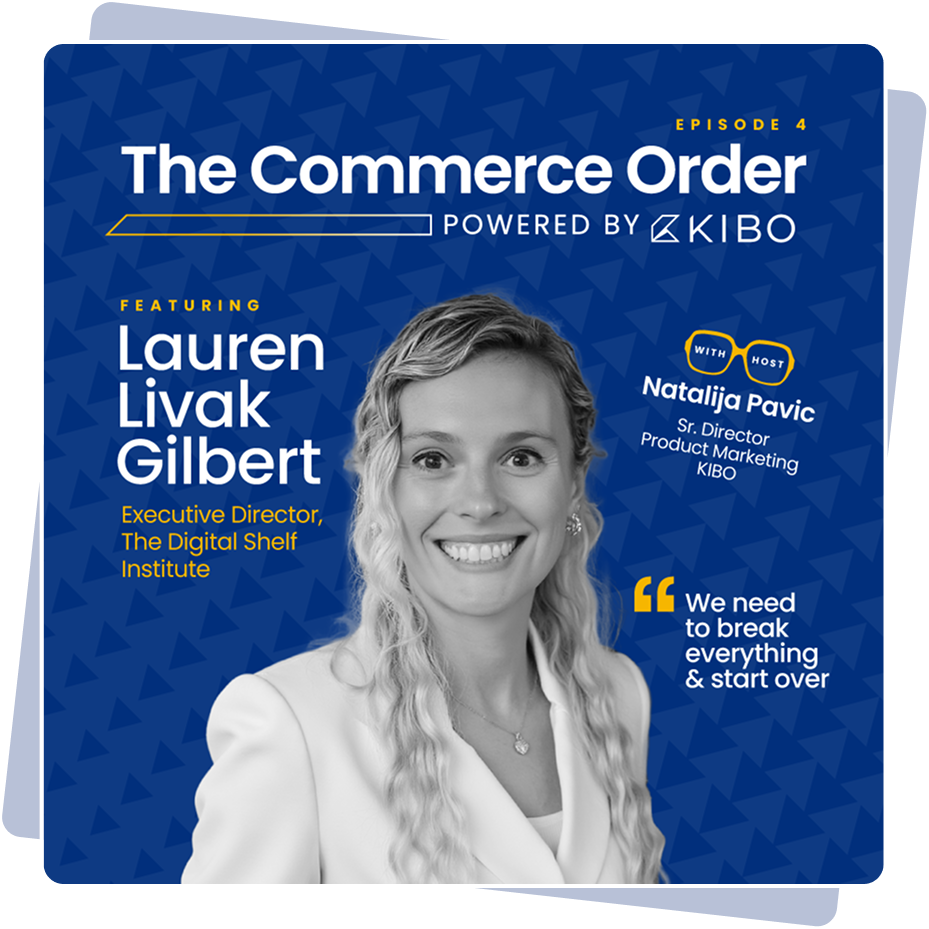
About the Guest

Lauren Livak Gilbert is Executive Director of the Digital Shelf Institute (DSI) and co-host of the Unpacking the Digital Shelf podcast. With over 10 years of experience in digital commerce and design, Lauren is a sought-after commerce strategist for hundreds of global omnichannel brands. While at Johnson & Johnson, Lauren launched a new, successful digital strategy for its Consumer North America business. At Salsify she worked with more than 80 global brands to develop a comprehensive commerce strategy, including staffing, technology investments, and performance-based processes. And at the DSI she connects with brands, retailers, tech partners and agencies to help advance the industry with her research and content.
Lauren Livak Gilbert, a leader at the Digital Shelf Institute, discusses the need for a fundamental shift in how businesses operate to align with modern consumer shopping habits. She challenges the traditional question of where e-commerce should sit within an organization, advocating instead for a complete re-evaluation of organizational structures and processes.
The conversation highlights key principles for the “org of the future,” including joint leadership across sales and marketing functions to ensure shared goals and accountability. This approach aims to eliminate internal friction and focus all efforts on overarching company objectives. Lauren also emphasizes the increasing role of AI as an enabler, foreseeing a future where human orchestrators are supported by specialized AI agents for various tasks, from content creation to optimization. The discussion touches on the evolving talent landscape, stressing the need for generalists who are agile and adaptable, rather than highly specialized individuals.
Show Highlights:
- Rethinking organizational structures to prioritize consumer-centricity over traditional departmental silos.
- The importance of joint leadership and shared goals for sales and marketing teams to drive unified business outcomes.
- How AI will transform work by enabling human orchestrators with specialized agents for tactical tasks.
- The shift in demand for generalist skill sets in the future workforce, emphasizing adaptability and a broad understanding of commerce.
- The critical need for companies to prepare their data infrastructure for AI adoption to avoid being left behind.
Transcript
00:00.69
Natalija Pavic
Hello, welcome to the show. Thank you so much for joining me here. I’m so excited to get to talk to you again. i always enjoy our conversation, but why don’t you tell me a little bit about who you are and what you do.
00:10.90
Lauren Livak Gilbert
Hey, Nat. Thanks for having me. Lauren Leva Gilbert. I lead the Digital Shelf Institute, and the Digital Shelf Institute is a community of digital leaders across the industry, mostly brand manufacturers and retailers.
00:23.62
Lauren Livak Gilbert
And the idea is to connect people across different organizations who are working in e-commerce, working in commerce, working in digital. And we produce a lot of content. We have our own podcast, Unpacking the Digital Shelf.
00:36.77
Lauren Livak Gilbert
We do a lot of research to develop best practices and frameworks, really just to help people who are in seat today do their job better.
00:44.76
Natalija Pavic
i And I’m such a huge fan of the Digital Shelf Institute and the work that you do. You’re but you’re probably one of my favorite researchers because you’re welcome. um Second only to Malcolm Cloud. No, just kidding.
00:55.82
Natalija Pavic
and Could you imagine? and he if you were
00:57.91
Lauren Livak Gilbert
my God, you’re comparing me to him?
00:58.78
Natalija Pavic
Could you imagine if he actually did research?
01:02.89
Natalija Pavic
He doesn’t do any research, don’t worry. I can’t compare you. can’t compare him to you. That’s what I wanted to say.
01:08.73
Lauren Livak Gilbert
Thank you. Thank you.
01:09.87
Natalija Pavic
You’re welcome. ah But no, what what I love about your research is it’s rooted in like the conversations that you have, that you facilitate with executives across brands. And so you’re just in the know, you’re you have access to this stuff.
01:21.92
Natalija Pavic
um And so let’s we’ll dive into your latest piece, which by the time of this airing will be published and available.
01:25.59
Lauren Livak Gilbert
Love it.
01:27.54
Natalija Pavic
So we’ll do a call to action at the end. But before we get there, What is an unpopular opinion that you have?
01:33.99
Lauren Livak Gilbert
ah Well, this unpopular opinion is directly connected to my research. ah But the question that most people ask is where should e-commerce sit in the organization? Like, should it sit in sales? Should it sit in marketing? Should it sit in a COE?
01:47.92
Lauren Livak Gilbert
And I actually think that’s the wrong question that we should be asking. And we need to stop asking that question. And we need to start asking, how are we changing the way we operate as a business to better match the way consumers shop?
02:00.79
Lauren Livak Gilbert
And I really… kind of think we need to break everything and start over in terms of how we think about org structure and org design.
02:08.51
Natalija Pavic
Wow. Okay. So after talking to all these smart people, you’re like, yeah, just change everything you’re doing.
02:15.10
Lauren Livak Gilbert
Yes. And it’s funny because in the research, I had a moment where I was like, I can’t really say that. So I need to build out a phased approach, which is what I did, and develop some like core mindset shifts and tenets.
02:26.55
Lauren Livak Gilbert
Because I know it’s easy for me to sit here and be like, break everything and start from scratch.
02:30.55
Natalija Pavic
Yeah.
02:31.12
Lauren Livak Gilbert
But there are some like very key principles that we just need to live by because we live in a different world, right?
02:31.37
Natalija Pavic
Yeah.
02:37.98
Lauren Livak Gilbert
It’s not the same as it used to be.
02:38.29
Natalija Pavic
yeah
02:39.46
Lauren Livak Gilbert
And we’re operating the way that we have been for the past 100
02:44.21
Natalija Pavic
Yeah. Well, you know, um and if I may digress a little bit, I think what’s interesting about what you’re saying is, okay, so everything has to change, but you’re not just going to say that. you’re going to actually give them the guidance for how it has to change, which I think is very smart of you to do that.
02:57.71
Lauren Livak Gilbert
Well, it’s a process too. It’s not like you can just like one day be like, we’re different.
02:59.14
Natalija Pavic
Yeah. Yeah.
03:02.95
Natalija Pavic
Yeah, but the thing that I’m thinking of is, is it, you know, are we like sort of adapting to technology? Like, do we now have to adapt to technology that’s available available and to work with, you the technology that’s available as opposed to taking the technology and forcing it on a structure that doesn’t actually support or doesn’t actually support digital initiatives?
03:23.66
Lauren Livak Gilbert
I think there’s a little bit of that as well as just ways of working. So what I mean by that is like e-commerce right now is just kind of a bolt on to a lot of organizational structures.
03:32.02
Natalija Pavic
Yeah.
03:33.69
Lauren Livak Gilbert
Like you have a bunch of people who get it or you have a COE and you just like bolt it on to your existing team to try and build out the capability.
03:37.65
Natalija Pavic
Yeah.
03:41.12
Lauren Livak Gilbert
And even for organizations who have, and I’m air quoting here, integrated e-commerce into their business, they’ve integrated it into a business that is built for in stores. Like your supply chain is built that way, your packaging design, just the way that you operate.
03:51.56
Natalija Pavic
Mm-hmm.
03:56.12
Lauren Livak Gilbert
So you’re still just kind of like bolting something on versus actually changing the way that you’re doing things and the way that you’re working. And technology is a huge enabler of that. And we finally have the technology that I think can get us to the point where we can actually do things more closely related to how consumers shop.
04:16.86
Lauren Livak Gilbert
But in order to do that, you fundamentally need to change how you work.
04:21.41
Natalija Pavic
That makes a lot of sense. It’s not like consumers are sitting around being like, oh, yeah, my order is late because they’re they’re struggling with operational efficiencies. It’s not like they’re – yeah.
04:29.08
Lauren Livak Gilbert
Yeah, the supply chain function didn’t talk to the marketing function. Yeah, exactly. They don’t care.
04:33.42
Natalija Pavic
And they don’t care. The consumer is just expecting a certain experience. And it’s funny because that’s what I think sometimes I drive my my husband crazy is because sometimes we’ll have those experiences and I will say that. I was like, oh, they don’t have this system or I figured it out. And he’s like, what does it have to do with anything?
04:50.56
Lauren Livak Gilbert
But it’s so funny you say that because I feel like all of us who kind of live in the commerce world talk about things like, do people know they’re sponsored ads on Amazon? And i was like, go pick someone off the street of New York City and say, hey, and like is this number one choice on Amazon sponsored?
05:05.33
Lauren Livak Gilbert
They’re going like, what does that even mean? Right? Like we live in our bubble and so we think it’s obvious.
05:07.18
Natalija Pavic
Yeah.
05:09.41
Lauren Livak Gilbert
But for like the regular person on the street who doesn’t work in our industry, it’s not.
05:14.95
Natalija Pavic
Yeah. Yeah. That’s it. That’s the interesting thing of being practitioners is that, you know, I’m always going around. i was like talking to my friends. I was like, yeah, so, so AI is, is huge and it’s going to change everything. they’re like, looking at me like, what are you talking about?
05:29.06
Natalija Pavic
I’m like, oh you guys are don’t think about and talk about this every single day.
05:32.24
Lauren Livak Gilbert
Yes. It’s funny you say that. i got I’m going to digress for a second. But like I think the thing that is so exciting to me around AI is we were all chatting about like chat GPT and perplexity and Gemini, right?
05:35.95
Natalija Pavic
and go ahead.
05:45.01
Natalija Pavic
Yeah.
05:45.33
Lauren Livak Gilbert
Because we’re in the industry and we’re talking about it.
05:46.48
Natalija Pavic
Yeah.
05:46.89
Lauren Livak Gilbert
But once Google started integrating AI into everything that they do, that’s like more of the regular person on the street who doesn’t work in tech is now using AI.
05:51.39
Natalija Pavic
Yeah.
05:55.88
Lauren Livak Gilbert
Yeah. And so it’s it’s more common and it’ll be more integrated into what they’re doing, which is which means it will drive the habit of using ai which previously, like, you wouldn’t get someone to go to a chat GPT if they didn’t know about it or didn’t work in this industry.
06:08.95
Natalija Pavic
Right.
06:10.21
Lauren Livak Gilbert
But everybody goes to Google to search.
06:12.28
Natalija Pavic
Right.
06:12.32
Lauren Livak Gilbert
And now that AI is fully integrated into Google, I think we’re going to see the adoption of it really increase, which is exciting to me because then behavior will actually change.
06:22.24
Natalija Pavic
Right, because ai would be used and consumers will use AI in ways that they or may not be aware that it is AI or isn’t AI.
06:31.03
Lauren Livak Gilbert
Exactly. And it’s accessible to everyone now. You don’t have to go to a separate app necessarily where not everybody knows what chat GBT is. Most people, but not everybody.
06:40.38
Natalija Pavic
Yeah, and that reminds me like, a very early conversation that I had, like, um whereas as we continue to digress. But um whatever.
06:46.17
Lauren Livak Gilbert
It’s our MO. Yeah.
06:48.91
Natalija Pavic
we just record we just plus the like We just pressed the play button today. What can you expect? um No, but I remember having an early conversation about GPT with somebody. um And, you know, I was like, you know, nobody…
07:01.00
Natalija Pavic
here knows about it because I live in Canada like you know my parents don’t my in-laws don’t know about it my friends don’t know about it and he was like well that’s weird like everybody I talk to is using it and i was like wait a minute where are you in the world yeah and he was like San Francisco and I was like oh no
07:14.33
Lauren Livak Gilbert
Who are you talking to? come
07:19.73
Lauren Livak Gilbert
on. That makes ton of sense.
07:22.53
Natalija Pavic
Okay, well, that, yeah, like, you know, depending on where you are, too, you either have more access to that stuff or more access to that information and or less access to it. it and It’s all kind of dependent on your community and how embedded you are, right?
07:36.43
Natalija Pavic
So anyway anyway this is not a question.
07:36.92
Lauren Livak Gilbert
Your echo chamber.
07:38.03
Natalija Pavic
Yeah, yeah ah you surround yourself with. So um now you’ve already introduced the Digital Shelf Institute.
07:40.64
Lauren Livak Gilbert
Mm-hmm.
07:43.90
Natalija Pavic
So that’s great. So my next question is going to be, what does the org of the future look like? What does your research tell us?
07:50.80
Lauren Livak Gilbert
Oh, fabulous question. So the research itself, I actually interviewed over 35 different digital leaders in multiple different functions across the org. So
08:00.29
Natalija Pavic
Yeah.
08:00.71
Lauren Livak Gilbert
not just e-commerce. I talked to supply chain, ah HR, legal, finance. Like I really wanted to get a better picture of an omni-channel org, what functions are involved and kind of what it looks like.
08:11.42
Lauren Livak Gilbert
And I got a sense of where it is today, which is everywhere. There is no standard. ah It’s in sales, it’s in marketing, it’s in the COE. And then I really kind of sat down to look at what are the more mature organizations doing?
08:25.09
Lauren Livak Gilbert
And then looking to the future with, especially with AI, how is that going to transform and how’s that going to change? So there’s a lot in the report and we’re not going to be to talk about all of it, but I wanted to kind of touch on a few of the key mindset shifts and just key principles of an org of the future.
08:42.32
Lauren Livak Gilbert
The first one being joint leadership. And what I mean by that is when I was talking kind of about that bolt on solution, the challenge is you have a lot of silos in an organization. So you have a sales organization that focuses on sales.
08:55.70
Lauren Livak Gilbert
a marketing organization that focuses on marketing. And they each report into separate leaders who usually report directly into the CEO.
09:00.22
Natalija Pavic
Mm-hmm.
09:03.25
Lauren Livak Gilbert
If you don’t have shared goals across the board, then the marketing and sales functions might not be working together. They might actually be working against each other. And so joint leadership puts in place, you can change the language, but chief growth officer, chief commercial officer who owns both sales and marketing,
09:22.37
Lauren Livak Gilbert
and has better visibility across the entire customer journey. And then everybody’s accountable for the same thing instead of working against each other. So that can look like many different flavors in many different organizations, but the whole point is sales and marketing reporting to the same leader and being accountable for the same things.
09:38.50
Natalija Pavic
Yeah.
09:41.82
Natalija Pavic
That’s so fascinating because they’ve, of you know, traditionally been separate and they traditionally kind of compete, you know, like marketing will say, well, we brought in this many leads and sales will say, well, we closed this many leads and we didn’t have enough leads, you know, and they’ll just go back and forth like that.
09:56.34
Natalija Pavic
But you’re right, like having the same metrics and having this could just get rid of a lot of unnecessary friction within the organization. Tell me about um the role of AI in all of this.
10:08.53
Lauren Livak Gilbert
Oh, gosh. Well, that’s a can of worms. But before before I get there, I just want to double click on one thing before we talk about AI, because that is huge.
10:10.46
Natalija Pavic
Sorry.
10:16.37
Lauren Livak Gilbert
You touched on shared goals. That’s another really big key tenant. So joint leadership and shared goals. You need to incentivize people to move towards the same North Star.
10:27.76
Lauren Livak Gilbert
So if you’re incentivizing the sales org to only focus on the sales number and the marketing number to only focus on engagement, What gets measured gets managed, right? So if their bonus is tied to that number, they’re going to drive towards that number.
10:40.84
Lauren Livak Gilbert
So the the real idea here is to make sure that everybody is focused on the overarching company goals. So if you have a goal to get to X percent of e-commerce growth, then your sales and marketing team should have that same goal.
10:53.95
Natalija Pavic
Mm-hmm.
10:54.13
Lauren Livak Gilbert
So everybody’s working together and you’re not working against each other. But the thing that I think we forget sometimes is we’re all humans. Right. Like we all want to have a very clear picture of what we need to do, what we need to achieve. We want to obviously make our bonus at the end of the year. So that’s where the incentives really come into play. And i was actually at Can Lions last week. And one interesting line that came from Stephen Bartlett.
11:19.47
Lauren Livak Gilbert
He was talking actually about measuring people based on how many experiments they’ve done versus a specific KPI or an outcome. And I think that’s a really interesting concept because we measure people on outcomes right now.
11:32.42
Natalija Pavic
yeah
11:32.69
Lauren Livak Gilbert
But if you want people to fail and to test and learn and to try things out, you can’t only measure them on outcomes. You have to measure them on how they experiment and try new things because you’re not creating an environment where you’re allowing them to do that.
11:48.19
Natalija Pavic
Wow. I hope my boss is listening because i would love to be measured on my experiments.
11:56.67
Lauren Livak Gilbert
How many things you try, that’s, but you have to fail to learn.
11:57.96
Natalija Pavic
Yes.
12:00.33
Lauren Livak Gilbert
And the other thing that kind of came out of that session, he was speaking with um someone from Diageo and she was saying, you just, you need to be able to experiment faster than your competition.
12:11.76
Lauren Livak Gilbert
Cause if you can, then you’ll eventually get to the answer faster, right?
12:14.66
Natalija Pavic
That is true.
12:15.03
Lauren Livak Gilbert
Because you can’t just automatically know what the future is. None of us really do. And everything is changing. So you need to experiment and you need to test and learn. In order to do that and and stay ahead and be the competition, you need to be experimenting more.
12:29.85
Natalija Pavic
Wow, that is fascinating. I hope my competition is not listening to this though so that they don’t…
12:34.03
Lauren Livak Gilbert
Nobody listen if you’re not’s competition.
12:37.99
Natalija Pavic
Get out.
12:40.85
Lauren Livak Gilbert
No, but I didn’t answer your question about AI. So I mean, I think AI is a really big piece of it. In the research report, I actually built out an example organization of the future with like an actual map of what it could look like.
12:50.50
Natalija Pavic
yeah yeah
12:52.49
Lauren Livak Gilbert
And the reality is a lot of organizations already are being enabled by AI, but I do see a world where it significantly becomes more of an enabler, where you have people that sit more at an orchestration level and then are supported by agents.
13:09.91
Lauren Livak Gilbert
So what I mean by that is, let’s say, for example, you’re um a specific part of a brand. So let’s say you’re in Food & Bev and you have a brand that’s centered around a need state, which is snacking, right? You’ll have a GM who runs that brand and then you’ll have a brand strategist who kind of acts as an orchestrator across the brand.
13:30.88
Lauren Livak Gilbert
That brand strategist will then have agents that help them. So they’ll have a briefing agent that helps kind of fill out the briefs for all of the different projects and campaigns that they have.
13:38.48
Natalija Pavic
Yeah.
13:41.23
Lauren Livak Gilbert
They’ll have a, um, AI agent who kind of acts as a focus group. So actually testing out content, they’ll have a content creation agent, and then they’ll have an optimization agent that’s actually constantly looking at the content and be able to optimize it for all the channels.
13:55.35
Natalija Pavic
Yeah. yeah
13:56.97
Lauren Livak Gilbert
So you have one human who’s supported by four to five different agents. And then that can happen in multiple areas across the organization and almost every different function. So the way you can think about it is a lot of the more tactical work can be replaced by the AI agents who are helping you to do things faster and more at scale, but it will never eliminate the human who is planning and strategizing and orchestrating and connecting the dots throughout all of the different functions across the organization.
14:30.03
Lauren Livak Gilbert
And in my research, I actually found there are some organizations today that work in that capacity. So they have one person who is an orchestrator who are supported by four to five different agents,
14:39.32
Natalija Pavic
Yeah.
14:41.24
Lauren Livak Gilbert
And they’re able to do the work of like 12 people, right? So this is a reality that exists today and I think will exist much more, but will be much more prevalent in the future.
14:46.48
Natalija Pavic
yeah
14:53.25
Lauren Livak Gilbert
But it really just depends on what the work is that’s getting done and how it’ll be enabled or replaced by AI.
15:01.30
Natalija Pavic
That’s fascinating. So you’re sort of like the the um the team of the future is these generalists supported by agents that completely changes even the profile of who you’re looking for.
15:08.70
Lauren Livak Gilbert
Correct.
15:14.37
Lauren Livak Gilbert
Oh, Nat, if if you, it’s just a perfect transition into my next point. So we did not plan this. This is amazing. um I think the answer to that is yes. And I think we are in a a position right now where I think we have a talent problem.
15:28.88
Lauren Livak Gilbert
And I’ve started talking about this a lot more. And it’s something I’m super, super passionate about because I don’t think we are recruiting for the leaders of the future.
15:33.91
Natalija Pavic
Yeah. Yeah.
15:37.96
Natalija Pavic
yeah
15:38.17
Lauren Livak Gilbert
And I don’t think we’re necessarily helping to develop but people in organizations today to be the leaders of the future because it’s shifting right you need to be way more well-rounded you need to understand in-store and online and d2c and social commerce you need to be dangerous in ah a lot of different areas versus being a specialist so that you can see across the entire customer journey but i think it’s a massive call to hr call to action to the HR teams, especially at larger organizations who have very, very traditional career paths.
16:07.55
Natalija Pavic
Yeah. Yeah.
16:12.78
Natalija Pavic
yeah
16:12.86
Lauren Livak Gilbert
I mean, just from my experience when I was at a large organization, it was really hard to take a more non-traditional career path because it had been mapped out that you do X number of years in this function, and then you move to this function, and then you move to this function, and then you can be a GM.
16:27.86
Lauren Livak Gilbert
But that world just doesn’t exist anymore. And We need to build out more leadership programs that are recruiting for more generalists who are agile and resilient and have all the characteristics of a digitally native person, but also understand the in-store element.
16:48.93
Lauren Livak Gilbert
And so I just really think that we need to career plan differently. we need to think about roles and responsibilities differently. And we need to think about how are we going to create the future leaders of tomorrow especially if AI is going to take away some of those entry-level jobs that would help a future leader get to that next stage of their career?
17:08.57
Lauren Livak Gilbert
And I don’t know the answer to that question. It’s just something I’m calling out.
17:12.50
Natalija Pavic
um No, that’s that’s wonderful. I mean, as some and you and I have this in common. I think we both took non-traditional career paths. think that could be said.
17:19.78
Lauren Livak Gilbert
Yes.
17:20.86
Natalija Pavic
um So it’s it’s interesting how so much of the last 10, 20 years in e-commerce has, you know, people have spent specializing.
17:30.13
Lauren Livak Gilbert
Mm-hmm.
17:30.32
Natalija Pavic
Specializing in one area, even in tech, specializing in one niche solution or one specific function. Now, I’ve heard this like entry-level jobs are disappearing. It’s interesting to me because on the one hand, yes, that’s going to be a challenge. On the other hand,
17:48.15
Natalija Pavic
can we just create new entry-level jobs? Like, this is what confuses me. Like, you can just create a new entry-level job for a generalist, right?
17:56.01
Lauren Livak Gilbert
Agreed.
17:56.11
Natalija Pavic
Like, you know, because you’re have to, to your point, build leaders and not, you’re not always going to be able to find leaders, the leaders that you’re looking for. So there has to be a little bit of room of, well, let’s create somebody that can learn, that can hop on, that can do a bunch of different things.
18:11.30
Natalija Pavic
That’s our new entry-level position. Like, I don’t understand what the holdup is. Yeah.
18:15.24
Lauren Livak Gilbert
We can do that. I just think the challenge is the same as introducing e-commerce to an organization that’s been selling in-store for 100 years. That is a massive change.
18:23.31
Natalija Pavic
Yeah. Yeah.
18:25.12
Lauren Livak Gilbert
And it’s a massive change for the people who are facilitating that, right? So like for the HR teams who are recruiting, who are writing the job descriptions, for the leaders to even understand that they need that.
18:28.57
Natalija Pavic
yeah
18:35.95
Lauren Livak Gilbert
I think… We are at a point, especially with AI and technology, that we’re just all still waiting to kind of figure out like what comes next and what changes.
18:43.60
Natalija Pavic
yeah
18:46.00
Lauren Livak Gilbert
I do agree that the the jobs will change what that entry level looks like. But the challenge is going to be if you are at an entry level and you are more of a generalist,
18:58.91
Lauren Livak Gilbert
In order to be a generalist, you also kind of have to get your hands dirty and you need to understand like how things work.
19:02.41
Natalija Pavic
Yeah.
19:04.69
Lauren Livak Gilbert
And then once you do that, you can kind of piece things together the right way.
19:08.34
Natalija Pavic
Yeah.
19:08.66
Lauren Livak Gilbert
So how do you do that if a lot of those jobs are done by an AI agent? I mean, i do think we have time, right? all of we We all sit here, especially like you and I, Nat, because we think about the future a lot.
19:20.10
Natalija Pavic
We think it’s going to happen tomorrow, like the way we see it.
19:21.66
Lauren Livak Gilbert
Exactly. It’s not.
19:22.58
Natalija Pavic
Yeah.
19:23.10
Lauren Livak Gilbert
It’s not. I mean, it could be 10 years. It could be 20 years. like
19:25.87
Natalija Pavic
Yeah.
19:26.50
Lauren Livak Gilbert
Think about e-commerce in general. like I’m still talking to brands about why it’s important and why they need to invest in it.
19:32.28
Natalija Pavic
Yeah.
19:32.46
Lauren Livak Gilbert
So change really does take time. But I think the difference between where we are now and past changes is it moves much more quickly. So once…
19:43.78
Lauren Livak Gilbert
the AI capability gets to a certain point, like you can use it. There’s no like waiting game, right? Like the internet adoption took a significant amount of time, but I don’t think that’s going to be the case for ai But if you don’t have the right infrastructure in place and you’re not prepared, then you’re going to be completely left in the dust.
20:02.36
Natalija Pavic
and And I think it’s interesting, you know, a lot of organizations are, um some of them are waiting the, you know, playing the wait and wait and see game. What are the use cases I should be using? you know, i want I want somebody else to establish that. But to your point, the more you experiment, like the organization that experiment, the the ones that take a limb and try it and figure out those use cases ultimately and become the winners, right?
20:24.72
Lauren Livak Gilbert
A hundred percent.
20:24.76
Natalija Pavic
Yeah.
20:25.31
Lauren Livak Gilbert
and And even just getting your data right, like bad data in, bad data out.
20:28.44
Natalija Pavic
Yeah.
20:30.18
Lauren Livak Gilbert
Like if you’re in the waiting game, don’t wait on your data, get that right. So then when you decide to get in the game with AI or you’re working with agentic search or whatever that looks like, geo, whatever acronym you want to use, generative engine optimization, you have the data ready to go.
20:46.24
Lauren Livak Gilbert
so that you can actually kind of be a player in that space versus just waiting and then starting to go through that. So that was kind of the point of this research. you Everybody’s at different stages of their maturity when it comes to org structure, when it comes to digital, but there’s just some like really key principles that you need to start thinking about no matter what stage of your journey you’re in, because change takes time. We all know that.
21:10.14
Lauren Livak Gilbert
And so if you’re planning for it now, then you’ll be set up for the future.
21:14.92
Natalija Pavic
Yeah.
21:15.18
Lauren Livak Gilbert
But if you just don’t do it, I’m just kind of scared for those companies that are going to be left in the dust because, i mean, think about it now.
21:20.98
Natalija Pavic
Yeah.
21:23.33
Lauren Livak Gilbert
you have all those small players that are kind of like ankle biting at the the larger brands and they’re feeling it now.
21:27.00
Natalija Pavic
Yeah.
21:30.46
Lauren Livak Gilbert
Imagine if you have AI and you have one human who’s created an entire brand and can do all of that work with ai agents and only has one human orchestrating it.
21:41.68
Natalija Pavic
Hmm.
21:41.72
Lauren Livak Gilbert
You won’t stand a chance against someone like that who has that power behind them.
21:45.14
Natalija Pavic
Yeah. Well, that’s a very, very strong call to action. So and we have time. and That’s like one side of the message, but the other side of the message is like, we don’t, we kind of don’t have time.
21:50.53
Lauren Livak Gilbert
Yes.
21:53.49
Natalija Pavic
So, so it’s be prepared.
21:54.49
Lauren Livak Gilbert
Be prepared.
21:56.27
Natalija Pavic
Yeah, exactly. No, I love it. um Now Omnichannel, let’s talk about how, know, obviously Omnichannel is something that we are still talking about. People are still doing, but you know, customers have shifted slightly.
22:08.08
Natalija Pavic
Tell me more about the implications of all of this on the current practice of Omnichannel and how that’s going to evolve.
22:14.40
Lauren Livak Gilbert
So omni-channel right now, I feel like it’s still a bit of a buzzword. And obviously there’s so many other words. There’s like unified commerce. There’s a bunch of other ways of talking about omni-channel. But I think the whole principle behind it is you need to be where your consumer is.
22:27.41
Natalija Pavic
Right.
22:28.01
Lauren Livak Gilbert
And you need to stop thinking about it as channels, which is how our org structures are set up to think about it. You have an in-store channel. You have a digital channel. You have a social channel, right? that That works because you needed to build up the capability. You need to get it ingrained in the organization and then you need to move on from there. But Omnichannel cuts all those walls down and actually helps you center on the consumer, which is where I think we all need to remain focused.
22:55.42
Lauren Livak Gilbert
But what that does is it takes a very complicated matrixed organization and means that you have to work together. So that’s really kind of the big challenge with Omnichannel. You need the retail media team to talk to the digital team who needs to talk to the supply chain team and the packaging team.
23:11.12
Lauren Livak Gilbert
So you’re crossing all of these different functions that may not have collaborated together in the past or might not have a way of working. So that’s really important inside your organization.
23:22.75
Lauren Livak Gilbert
and What I found in the research is, I like to call it, we we don’t like we don’t have a box problem, meaning like we don’t have like a people problem in terms of like the where they report to and such. We have an incentive problem and a job description problem.
23:37.70
Lauren Livak Gilbert
Like people need to understand what they own and how they’re collaborating across the organization. as well as how their metrics, which we which we talked about before. But you have like kind of the right people in the right places. You just need to kind of rejigger how you’re thinking about them and how they’re working together in order to be omni-channel, which really means stop thinking in channels and start thinking in how the consumer shops.
24:01.12
Natalija Pavic
That’s interesting because, and I think you’re right, I i think even that word omni-channel is forcing us to think about channels and forcing us to think that we have all of our ducks you know um in a row for every single channel, that kind of thinking.
24:07.48
Lauren Livak Gilbert
Yeah.
24:14.19
Natalija Pavic
And to your point, it’s no longer about that. It’s it’s not about which channel is performing or outperforming. It’s where is the customer and how is their experience. It’s a fundamentally different shift in perspective, right?
24:25.88
Natalija Pavic
Yeah.
24:26.53
Lauren Livak Gilbert
It’s a mindset shift. Yeah.
24:27.61
Natalija Pavic
Yeah.
24:27.81
Lauren Livak Gilbert
And if you if you download the research and you look at the example org structures, you’ll see that nowhere is e-commerce called out because it’s ingrained in absolutely everything that is being done.
24:35.17
Natalija Pavic
Hmm. Ah, yeah. Yeah.
24:39.47
Lauren Livak Gilbert
You’re not going to see an e-commerce team. You’re just going to see a brand team and they have responsibilities for in-store, online, social, right?
24:43.06
Natalija Pavic
Yeah.
24:46.13
Lauren Livak Gilbert
So the future org is not calling out all of these different channels. You are just focused on the consumer.
24:52.63
Natalija Pavic
and that and that’s And that leads to like, we’ve sort of been seeing the dropping of the E in e-commerce and we’re sort of all adopting this word commerce and commerce is a lot broader of a term. But um so that totally tracks with where we’re going. Now, before we move on, I did want to get your take or your definition of what agents are because, you know, we talked about that.
25:12.59
Natalija Pavic
But um I think it’s just I’m just enjoying getting everybody to define it. So why don’t you define it for us?
25:18.34
Lauren Livak Gilbert
Yeah, sure. So the way that I would think about agents is it’s using an LLM to be able to do a specific task. So I think of like agentic AI as like a Rufus or Sparky on Walmart.
25:29.27
Natalija Pavic
Yeah,
25:29.65
Lauren Livak Gilbert
So you’re using actual like gen AI technology to actually perform a task or answer a question or do an action. And that’s the context as to which I think about it from an org structure model, right? Like you’re using an agent to help you execute on retail media or ah write out a content brief.
25:46.27
Natalija Pavic
yeah. yeah
25:50.20
Lauren Livak Gilbert
So you’re using those LLMs to actually do an action.
25:53.79
Natalija Pavic
Yeah, and it’s an interesting distinction because I think sometimes you can have an agent that’s not AI-based, right? So I think people also have to understand that you could have an autonomous agent that does very deterministic things that you tell it to do and takes action.
26:06.99
Natalija Pavic
But then agentic AI, as you mentioned, you pointed out, can understand context, have a natural conversation with you, but then from that to the actions that it’s been sort of programmed to do. So thank you for that.
26:18.30
Lauren Livak Gilbert
Yeah, you’re welcome.
26:18.52
Natalija Pavic
um so um let’s talk about
26:26.50
Natalija Pavic
So with all this talk, what can AI help us do with the Omnichannel that we couldn’t do before?
26:32.13
Lauren Livak Gilbert
Well, I think it’s super exciting because if I think back to my brand days, we were talking about like doing seasonal content and personalized content by channel. And it was this like beautiful thing that we wish we could do, but we didn’t have enough people to support it.
26:46.07
Lauren Livak Gilbert
Now with AI, you can actually do that. Like you can actually use AI content creation to create seasonal content, to constantly optimize, to personalize your content.
26:56.86
Lauren Livak Gilbert
And that is a world that exists today. So it’s just so exciting to me that it enables you to do that because that’s what the consumer wants, right? Like you and I, Nat, like I don’t want anything that’s not gluten-free in front of me because I’m gluten-free, right?
27:08.79
Natalija Pavic
Mm-hmm.
27:09.20
Lauren Livak Gilbert
How can you personalize my content and make sure that you are providing relevant content to me versus to you, Nat. And in order to do that without AI, that would take 15, 20 people with multiple systems and you would never be able to do it for all of your different retailers or channels.
27:26.66
Lauren Livak Gilbert
But now it’s possible. And it’s so exciting because it’s really upping the ante for all these brands where The basics, I’m air quoting, of content would have gotten you kind of like in in the door and then you had to kind of enhance it.
27:42.20
Lauren Livak Gilbert
The basics are really, they’re they’re changing. They’re getting higher and higher of what basic content needs to be on your product detail page in order to be engaging and to feed the algorithm and agentic AI.
27:50.23
Natalija Pavic
Yeah.
27:53.25
Lauren Livak Gilbert
And now personalization is real.
27:56.41
Natalija Pavic
Yeah. and And it’s, you know what, people are, to your point, like sometimes they’re they’re scared that, you know, this is going to take jobs away, but there’s so much in e-commerce and commerce that would like we’re just not able to do today.
28:06.45
Lauren Livak Gilbert
Exactly.
28:06.68
Natalija Pavic
And product information is a huge one. Product details, product photos.
28:10.91
Lauren Livak Gilbert
Taxonomy.
28:11.69
Natalija Pavic
Yeah. It’s just so complicated. Yeah. It’s kind of exciting to be in a world where we will actually be able to achieve that and exciting to think of of what that could look like.
28:20.80
Lauren Livak Gilbert
Oh, the possibilities.
28:23.29
Natalija Pavic
So thank you. That has been a very enlightening conversation. I have one last question for you, which is what was the last thing you bought online?
28:28.53
Lauren Livak Gilbert
ready.
28:31.93
Lauren Livak Gilbert
So a new harness for my dog, uh, because he’s now 105 pounds. And so he’s surpassed the harness that we had before.
28:36.76
Natalija Pavic
Oh.
28:39.45
Lauren Livak Gilbert
It did not fit him. Uh, and it actually took a while for me to find a harness because he’s so big and he’s a specialty kind of breed that has like a very wide chest. So I actually used AI to help me find a harness that worked for Rhodesian Ridgebacks.
28:54.40
Lauren Livak Gilbert
Uh, but I ended up buying it on Amazon.
28:56.65
Natalija Pavic
um I’d love to see a photo of you and your giant dog sometime. I think it’d be hilarious.
29:00.86
Lauren Livak Gilbert
Yes, I will.
29:03.17
Natalija Pavic
So thank you for that. um Well, Lauren, where can people find your research?
29:10.44
Lauren Livak Gilbert
and then just click on resources and it’ll be right there on the top. It is the reinvented org of the future.
29:16.74
Natalija Pavic
And you can also be found on LinkedIn and as one of the hosts of the Digital Shelf Podcast, right?
29:20.10
Lauren Livak Gilbert
Yes. Yep. Unpacking the digital shelf and feel free to connect with me on LinkedIn. Always happy to chat.
29:27.04
Natalija Pavic
Thank you very much. um And to everyone else, and until next time.