In wholesale trading sub-sectors such as apparel and footwear, home furnishings, grocery, and seasonal goods, profitability is dictated by vendor scorecards, compliance rules, and deduction management. Wholesalers operate on two competing order clocks: seasonal pre-books placed months in advance, and urgent at-once reorders competing for the exact same inventory pool. Managing these requires connected commercial and operational context so businesses can win the order, keep the promise, and protect the margin.
The Pre-Book vs. At-Once Collision
Wholesale order mechanics differ fundamentally from retail carts. Take this example, in March a retail account commits to a seasonal pre-book for 50,000 units, delivered across staggered dates and locations from August through November. If factory production slips by two weeks, the retail buyer’s must-arrive-by date (MABD) does not move. Under a standard first-come, first-served order queue, incoming stock gets consumed by small spot orders, leaving the wholesaler unable to fulfill the major retail account’s pre-book.
Failing a major retail partner is expensive:
- Margin eroding chargebacks: Retailer compliance chargebacks and deductions quietly consume margin one failed requirement at a time.
- OTIF penalties: Under Walmart’s on-time in-full (OTIF) guidelines, non-compliant shipments face a 3% penalty fee, with similar compliance programs across major retailers.
- Data-driven errors: Many chargebacks trace back to EDI and data formatting errors such as missing advanced shipping notice (ASN) fields and unhandled EDI 850 feeds rather than physical shipping mistakes.
Why KIBO for B2B Wholesale
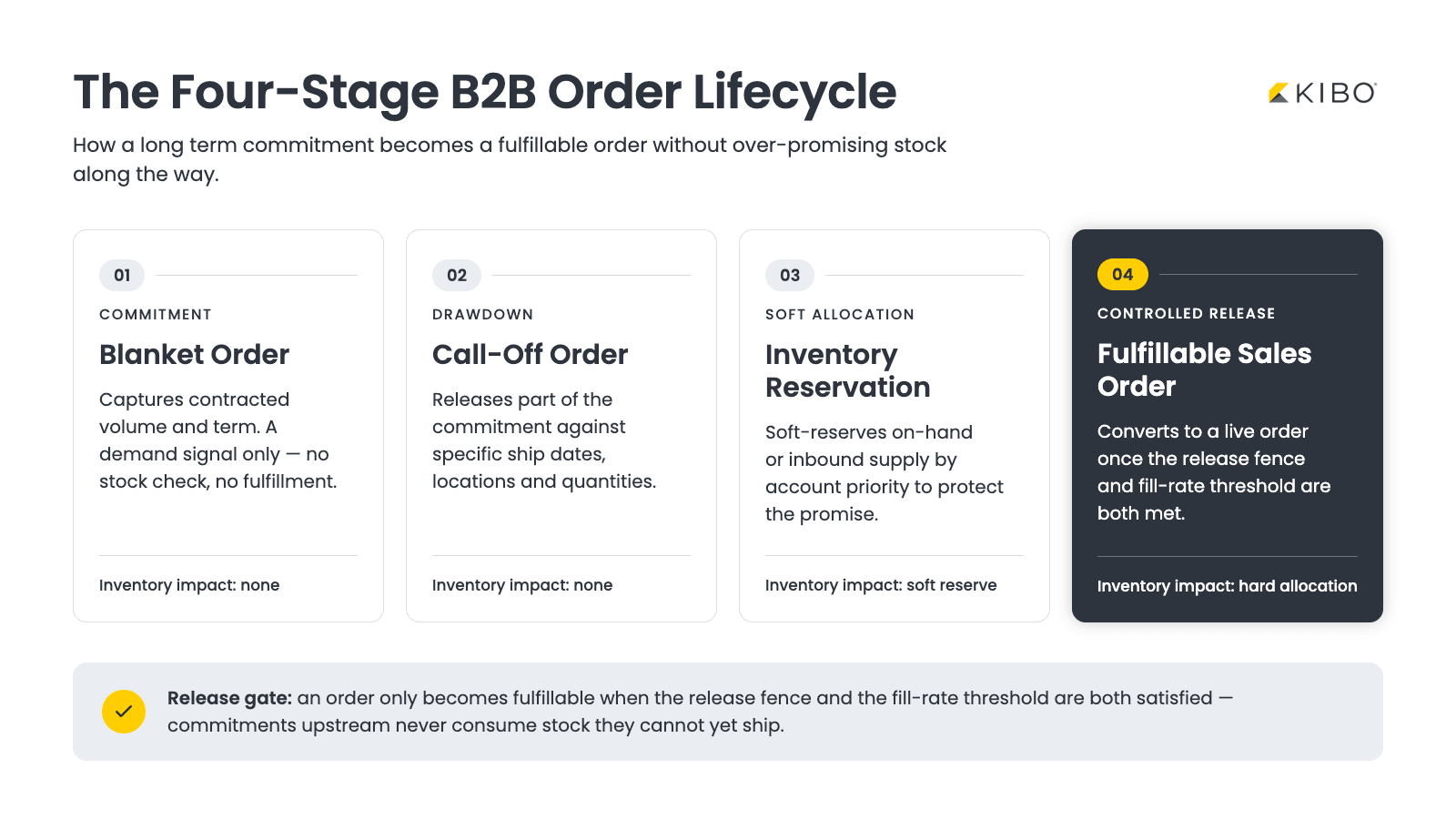
KIBO’s wholesale order management replaces rigid first-come, first-served queues with a four-stage orchestration model built for where supply meets demand:
- Stage 1: Commitment (blanket orders): A seasonal commitment tracks contract volume and price lists over a validity window, without holding physical inventory or triggering premature fulfillment.
- Stage 2: Drawdown (call-off orders): Line-item delivery requests specify requested ship dates, destination addresses, and quantities, drawn against the blanket order or submitted as standalone call-offs.
- Stage 3: Allocation (inventory reservations): A logic-based engine ring-fences current on-hand stock or future inbound supply by strategic account priority, so a pre-book never loses its allocation to an opportunistic spot order. Segmentation and reservation logic are configurable per location and can be adjusted as supply realities change, protecting key accounts when a factory slips.
- Stage 4: Controlled release (sales orders): Account-priority release workflows convert call-offs into fulfillable sales orders when the timing and completeness conditions you configure are met, keeping account spend inside its purchase limits and inventory inside its promise.
EDI runs through the same platform (850, 855, 856, 810, and 846 transactions, alongside REST API integrations for real-time inventory and status), so compliance is enforced at capture instead of repaired after the fact.
The proof is in client results: A prominent consumer electronics and home audio manufacturer selling wholesale reduced its cancellation rate by 28%, and KIBO’s B2B clients report a 67% average decrease in returns. As documented in The Total Economic Impact™ of KIBO, a commissioned Forrester Consulting study (2025), KIBO delivers 167% three-year ROI with payback in under six months, so wholesalers protect their margins before shipments ever leave the dock.
See wholesale orchestration in action: request a demo.