For wholesale distributors across industrial, electrical, plumbing/HVACR, and building materials, market demand has stabilized while gross margins remain under structural pressure. When multiple distributors quote the exact same manufacturer part number to the same contractor, growth cannot come from price increases. It has to come from service velocity, fill rates, and a lower cost-to-serve per order; bridging connected commercial and operational context to win the order, keep the promise, and protect the margin.
The Multi-Branch Disconnect
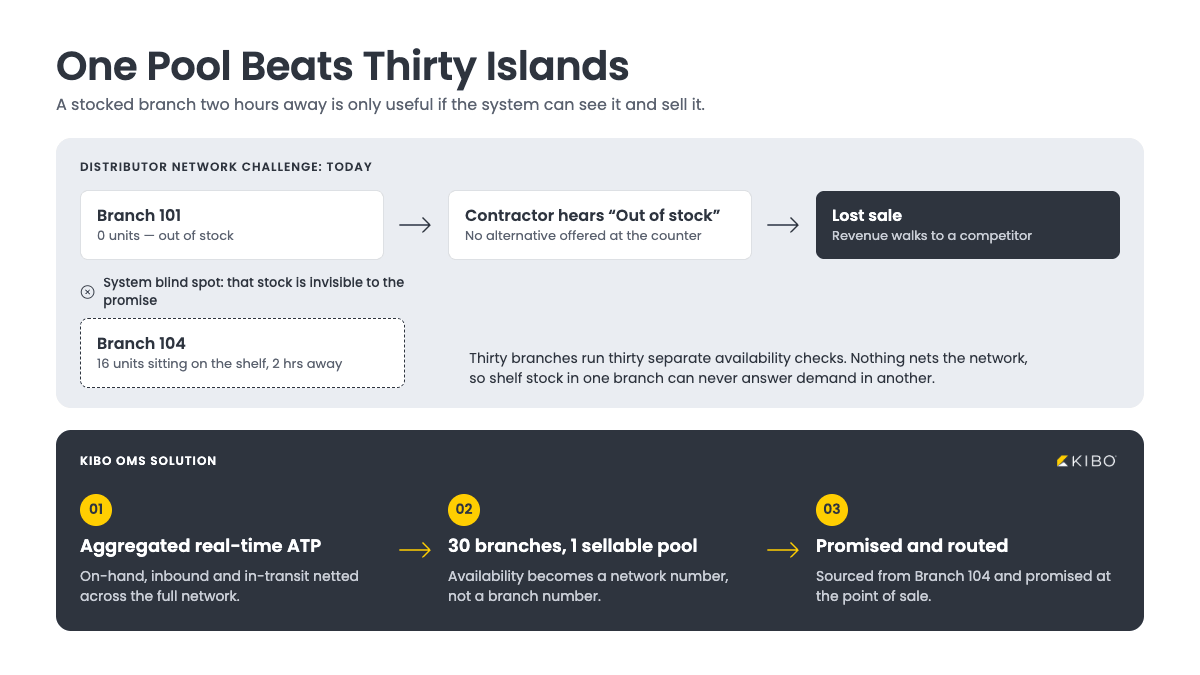
A distributor’s greatest physical asset is network proximity: stocking locations within a short drive of job sites. But whether you run three branches or two hundred, most legacy ERPs treat each branch as an isolated inventory bucket. When a contractor at the counter at 6:00 AM or on the web portal asks for a critical fitting, the system evaluates only local branch stock. If Branch A is out, the portal displays “Out of Stock” or “Call for Availability” even when 14 units sit on the shelf at Branch B two hours away. Meanwhile, buyers now expect the self-service, accurate inventory, and reliable delivery they get as consumers, and duplicate safety stock piles up at every node because nobody trusts the network view.
Project-based orders compound the problem. A contractor locks in a project quote in March with releases scheduled through Q4. When call-off releases ship in August, legacy carts attempt to re-price lines at spot rates, forcing manual customer service rep. overrides that delay shipments and trigger billing disputes.
Why KIBO for Wholesale Distribution
KIBO’s distribution order management turns a fragmented branch network into a single, real-time sellable pool where supply meets demand, without a risky ERP overhaul:
- Aggregated real-time network ATP: Stock across distribution centers, branches, 3PLs, and vendor locations rolls into one available-to-promise (ATP) view that factors in transit times, lead times, and SLAs, so counter staff and portals can commit firm delivery dates, even on non-stocked SKUs.
- Contract pricing that survives the release schedule: Negotiated pricing lives in contract price lists, quotes flow into orders without re-keying, and blanket commitments with call-off orders have configurable release logic, so March’s negotiated price holds through every Q4 release.
- Routing on total fulfillment cost: Logic-based routing balance margin against SLAs across DC, branch, 3PL, will-call, and dropship fulfillment, with capacity limits that guard against overcommitment and smarter sourcing decisions that reduce split shipments and premium freight.
- Protection for your highest value accounts: Inventory segmentation ring-fences stock by account or channel, so a walk-in order never takes the allocation promised to a strategic account.
The results are documented: A large aftermarket parts distributor was able to cut average hours-to-fulfill by 39%, and a life sciences contract development and manufacturing organization (CDMO) reduced average shipments per order by 47%. Across KIBO’s B2B clients, the average decrease in shipments per order is 50%, meaning all of that freight savings goes straight to the bottom line.
Ready to unify your branch network? Speak with a distribution expert.