When an enterprise contractor stands at a branch counter at 6:00 AM needing a replacement valve to keep a job site on schedule, or an equipment dealer orders a critical part to bring a stalled factory line back online, they are not merely browsing a product catalog. In B2B commerce, buyers aren’t just buying a part. They’re buying a date, a price, and total confidence that both will hold because Kibo is where supply meets demand in real time. Buyers need a provider that can help win the order, keep the promise, and protect the margin.
Yet across the mid-market and enterprise landscape, a structural disconnect keeps breaking those promises. Most legacy ERP infrastructure was engineered decades ago as a back-office financial ledger: a system of record for accounting events, not a real-time engine for computing available-to-promise (ATP) inventory across complex multi-node networks. Your ERP wasn’t built for this. A B2B order management system was.
The High Cost of Disconnected Systems
When digital storefronts, field sales apps, and customer service portals operate without real-time synchronization to warehouse ledgers, customer-facing teams routinely promise inventory that isn’t available. Supply chain teams then pay to rescue those promises after checkout: checking branch stock by phone, re-keying purchase orders out of emails and PDFs, paying premium expedited freight, and splitting a single 50-line order across three shipments.
The financial toll compounds fast:
- Manual processing labor: The Institute of Financial Operations puts the cost of processing a manual B2B order at $30 to $80, versus $1 to $5 through an integrated portal. Every hand-keyed line is also an error waiting to happen.
- Freight margin erosion: Splitting orders into multiple shipments to rescue a delivery date quietly erodes gross margin.
- Customer churn: Buyer expectations have already shifted. Gartner’s 2026 B2B Buying Survey found 67% of B2B buyers now prefer a fully sales rep-free buying experience, and TreviPay research found 82% would switch to a vendor that offers invoicing at checkout with net terms. Buyers who can’t see accurate stock and reliable delivery dates simply buy somewhere else.
The Difference: Both Sides of the Pane on One Data Model
Traditional order management implementations fail for a structural reason: standalone supply chain platforms sit behind someone else’s buying experience. They manage order routing in the back office while the buyer’s screen stays disconnected. The result is two data models, two vendors, and a brittle point-to-point integration that drifts out of sync, lacking the essential connected commercial and operational context required to reliably fulfill orders.
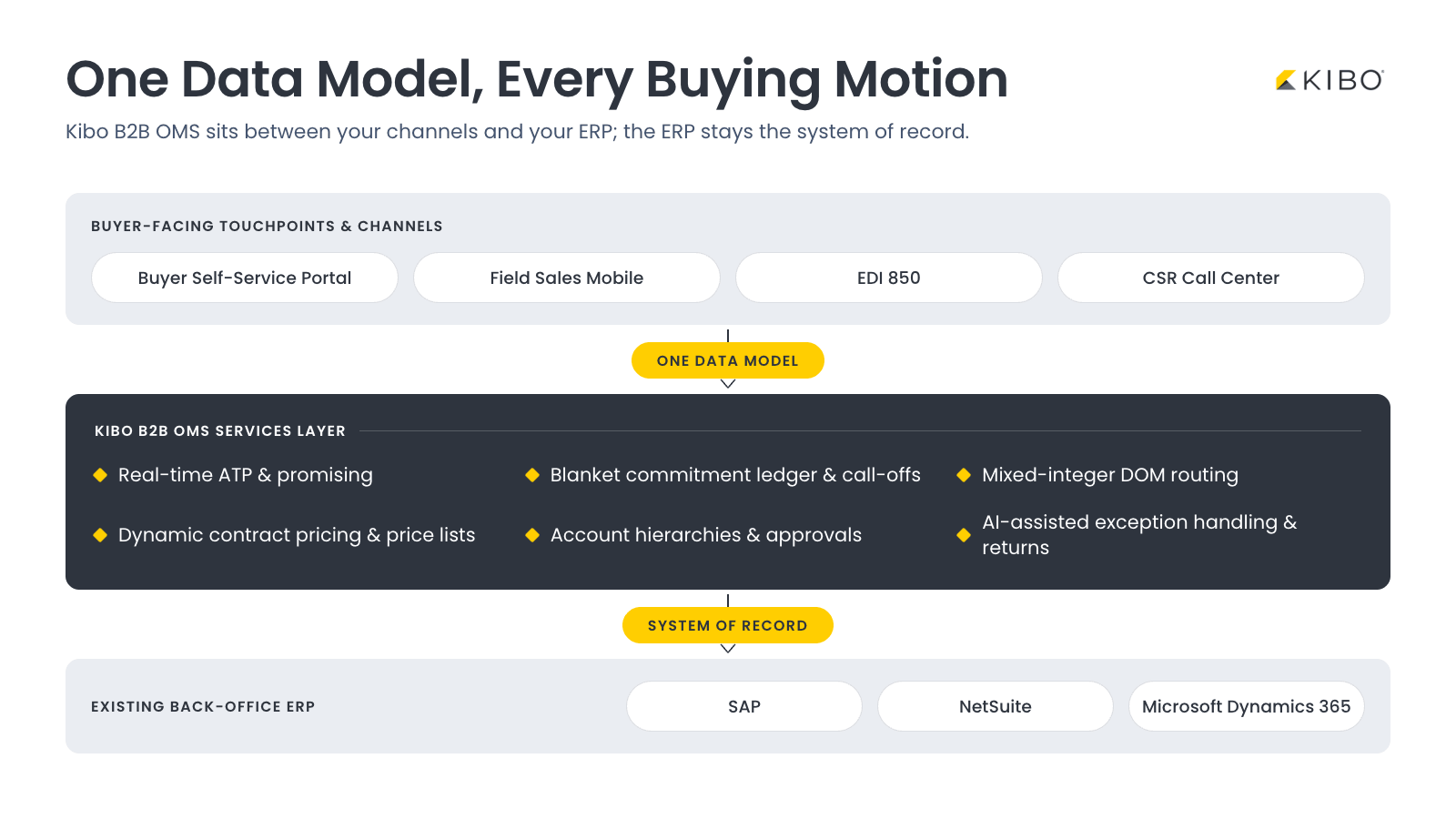
KIBO closes this gap by running B2B Commerce and Order Management on one data model. Price, ATP stock, and scheduled delivery dates are computed once and reflected consistently across every touchpoint: the buyer portal, the dealer site, the branch counter, the EDI 850 acknowledgement, and the customer service reps screen. What your buyer sees matches what your warehouse acts on. When a buyer sees a delivery date at checkout, that is the date the operation is committed to execute.
The industry has taken notice: KIBO is the only Leader in The Forrester Wave™: Commerce Solutions, Q3 2026 to also be named a Leader in The Forrester Wave™: Order Management Systems, Q1 2025. In the OMS evaluation, KIBO earned the highest possible scores across 18 criteria, received the highest score in the strategy category, and was the only vendor in the evaluation to earn the customer favorite designation. In August 2026, KIBO was also named a Leader in the IDC MarketScape: Worldwide AI-Enabled Order Orchestration and Fulfillment Applications for B2B and Manufacturing 2026 Vendor Assessment, an evaluation built around exactly the problems described above: contract complexity, multi-tier distribution, and allocation under constraint.
Audited ROI and ERP Preservation
Enterprises do not need a high-risk, multi-year ERP replacement program to achieve order promise integrity. KIBO is a composable, API-first digital services layer that sits above your existing ERP, normalizing orders, inventory, and pricing data whether you run one ERP or five.
According to The Total Economic Impact™ of KIBO, a commissioned Forrester Consulting study (2025), enterprise organizations implementing KIBO Order Management achieved:
- 167% three-year ROI with $8.0M net present value.
- Full platform payback in under six months.
- 47% decrease in average shipments per order
- 39% decrease in average hours to fulfill
By aligning storefront commitments with warehouse execution on a single data model, KIBO enables B2B organizations to stop reacting to their order book and start running it to a profitable plan.
See KIBO’s B2B order management in action: request a demo.